
Introduction
In today's fast-paced sales environment, every second counts. Sales development representatives, account executives, and managers spend countless hours on calls, only to lose valuable time manually documenting conversations and extracting key insights. This is where ai call summaries transform the game. By leveraging artificial intelligence to automatically transcribe, analyze, and summarize sales calls, teams can reclaim hours of productivity while capturing crucial details that drive revenue.
According to research published in the National Institutes of Health, AI-generated encounter summaries reduce provider documentation time significantly, with a 6-month pre-post analysis showing substantial time savings in note summarization. In the contact center space, AI call summaries reduce wrap-up time by up to 8x, allowing agents to handle more calls while maintaining compliance standards.
This comprehensive guide explores everything you need to know about ai call summaries in 2026 from understanding the technology to implementation strategies that deliver measurable ROI for B2B sales teams.
What Are AI Call Summaries?
AI call summaries are automatically generated reports that capture the essential elements of a sales conversation. Unlike traditional manual note-taking, these intelligent systems use natural language processing and machine learning to transcribe calls in real-time, identify key discussion points, extract action items, and generate structured summaries without human intervention.
Core Components of AI Call Summary Technology
Modern ai call summaries integrate several sophisticated technologies working in concert:
- Speech Recognition: Converts spoken words into accurate text transcriptions with speaker identification
- Natural Language Processing (NLP): Understands context, sentiment, and intent behind conversations
- Machine Learning Models: Identifies patterns, extracts key information, and improves accuracy over time
- Semantic Analysis: Categorizes topics discussed, questions asked, and objections raised
- Action Item Extraction: Automatically identifies follow-up tasks, commitments, and next steps
When integrated with a power dialer system, these capabilities create a seamless workflow where calls are automatically recorded, transcribed, and summarized without disrupting the sales process.
How AI Call Summaries Work in Sales Environments
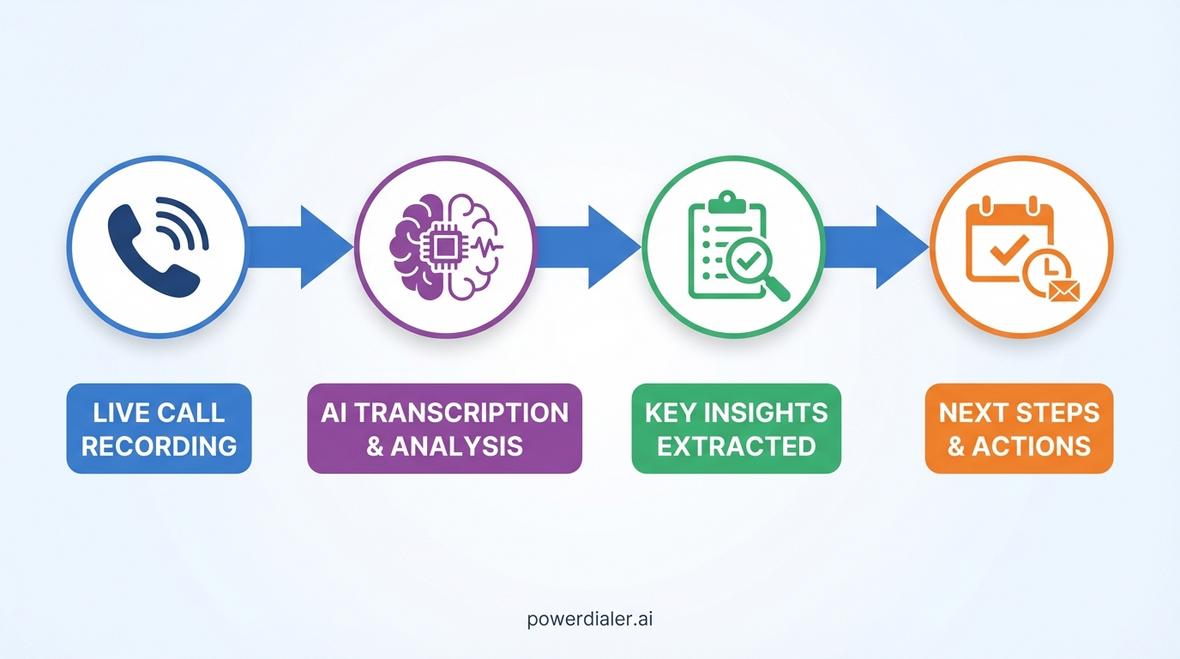
Understanding the workflow behind ai call summaries helps sales leaders appreciate the technology's value proposition. The process typically unfolds in four distinct stages:
Stage 1: Live Call Recording
The moment a sales representative connects with a prospect, the system begins capturing audio data. Modern platforms like PowerDialer.ai automatically initiate recording with proper consent notifications, ensuring compliance with regulations across different jurisdictions.
Stage 2: AI Transcription & Analysis
As the conversation unfolds, advanced AI engines transcribe speech to text with remarkable accuracy often exceeding 95% even with industry-specific terminology. The system simultaneously performs sentiment analysis, identifies speaker changes, and begins cataloging discussion topics.
Stage 3: Key Insights Extraction
Once the call concludes, AI algorithms process the complete transcript to identify:
- Pain points mentioned by the prospect
- Budget discussions and pricing concerns
- Decision-makers involved in the buying process
- Competitor mentions and objections raised
- Product features discussed or demonstrated
- Timeline expectations and buying signals
Stage 4: Next Steps & Actions
The final stage converts insights into actionable outputs. The system generates a structured summary highlighting the most critical information and automatically creates follow-up tasks, schedules reminders, and updates CRM records with relevant data.
Transformative Benefits of AI Call Summaries for Sales Teams
The impact of implementing ai call summaries extends far beyond simple time savings. Organizations across industries report multiple compounding benefits:
Dramatic Time Savings
Sales representatives spend an average of 15-20 minutes per call on manual documentation. With AI automation, this drops to under 2 minutes for review and refinement. For a rep making 50 calls per week, this translates to reclaiming 12+ hours monthly time that can be redirected toward revenue-generating activities.
Improved CRM Data Accuracy
Manual data entry introduces errors and inconsistencies. AI call summaries ensure that every conversation detail flows into your CRM with perfect accuracy. This creates a reliable foundation for analytics and reporting that drives strategic decisions.
Enhanced Sales Coaching Opportunities
Sales managers gain unprecedented visibility into team performance. Instead of relying on anecdotal reports or sitting in on live calls, managers can review AI-generated summaries to identify coaching opportunities, celebrate wins, and address skill gaps. The AI sales coach feature takes this further by providing real-time guidance during conversations.
Better Customer Experience
When sales reps have instant access to complete conversation history, they never ask prospects to repeat information. This continuity demonstrates professionalism and respect for the customer's time, significantly improving relationship quality.
Compliance and Legal Protection
For industries with strict regulatory requirements, ai call summaries provide automatic compliance documentation. Every call is transcribed and archived with timestamps, creating an audit trail that protects organizations during regulatory reviews or disputes.
Essential Features to Look for in AI Call Summary Solutions
Not all AI call summary platforms deliver equal value. When evaluating solutions for your sales organization, prioritize these critical capabilities:
Real-Time Transcription Accuracy
The foundation of effective summaries is accurate transcription. Look for systems that achieve 95%+ accuracy rates even with accents, industry jargon, and background noise. Real-time processing ensures summaries are available immediately after calls conclude.
Customizable Summary Formats
Different sales processes require different information hierarchies. The best platforms allow teams to customize summary templates based on call type whether discovery calls, product demos, or closing conversations.
Seamless CRM Integration
AI call summaries deliver maximum value when data flows automatically into your existing systems. Native integrations with popular CRMs like Salesforce, HubSpot, and Pipedrive eliminate manual data transfer and ensure nothing falls through the cracks.
Advanced Sentiment Analysis
Understanding the emotional tone of conversations helps reps gauge prospect interest and adjust their approach. AI systems that track sentiment shifts throughout calls provide invaluable coaching insights.
Multi-Language Support
For organizations operating in global markets, multi-language transcription and summarization capabilities are non-negotiable. Systems should handle code-switching and maintain accuracy across languages.
Security and Compliance Features
Given the sensitive nature of sales conversations, robust security measures are essential. Look for solutions offering encryption, role-based access controls, and compliance with regulations like GDPR, CCPA, and industry-specific requirements.
Implementation Strategies for Maximum ROI
Successfully deploying ai call summaries requires thoughtful planning and change management. These proven strategies accelerate adoption and ROI:
Start with a Pilot Program
Rather than organization-wide rollout, begin with a small team of enthusiastic early adopters. This allows you to refine workflows, gather feedback, and build internal champions who can advocate for broader adoption.
Establish Clear Processes
Define how AI-generated summaries fit into your existing sales workflow. Specify when reps should review summaries, how they integrate with CRM updates, and what information requires human validation versus automatic acceptance.
Provide Comprehensive Training
Even intuitive systems benefit from structured training. Ensure your team understands how to leverage summaries for follow-up, use insights to personalize outreach, and incorporate AI recommendations into their sales approach.
Measure Key Performance Metrics
Track specific KPIs to quantify impact:
- Time saved per call on documentation
- CRM data completeness and accuracy rates
- Follow-up task completion rates
- Sales cycle length changes
- Win rate improvements
- Revenue per representative
Iterate Based on Feedback
Regularly solicit feedback from users and adjust configurations, summary templates, and workflows accordingly. The most successful implementations treat AI call summaries as an evolving system that improves continuously.
Industry-Specific Applications of AI Call Summaries
Different industries leverage ai call summaries in unique ways tailored to their specific challenges:
B2B Sales and SaaS
Complex B2B sales cycles involve multiple stakeholders and lengthy conversations. AI summaries help account executives track buying committee members, document technical requirements, and ensure consistent messaging across multiple touchpoints. Organizations in B2B sales environments particularly benefit from the ability to share summaries with solution engineers and implementation teams.
Real Estate
Real estate agents juggle dozens of client conversations simultaneously. AI call summaries automatically capture property preferences, budget constraints, location requirements, and showing feedback, ensuring agents never miss critical details. The technology proves especially valuable in real estate industry applications where timing and personalization drive success.
Financial Services
Compliance documentation is paramount in financial services. AI call summaries provide automatic transcription and archiving that meets regulatory requirements while capturing investment preferences, risk tolerance, and advisory recommendations. Financial services organizations rely on these capabilities to balance productivity with regulatory obligations.
Healthcare and Pharma
Healthcare sales representatives conducting physician outreach need precise documentation of clinical discussions, formulary status, and prescribing patterns. AI summaries ensure accuracy while reducing administrative burden, critical for healthcare industry professionals managing complex product portfolios.
Legal Services
Law firms use AI call summaries to document client intake calls, case discussions, and consultation details with precision. The technology creates searchable transcripts that support case preparation and billing accuracy, valuable for legal professionals managing high call volumes.
Best Practices for Maximizing AI Call Summary Value
To extract maximum value from ai call summaries, implement these proven best practices:
Review Summaries Immediately After Calls
While AI generates summaries automatically, human review adds context and catches edge cases. Establish a habit of reviewing summaries within 15 minutes of call completion while details remain fresh.
Customize Templates for Different Call Types
Discovery calls require different information capture than closing calls. Create specialized summary templates that align with your sales methodology and conversation objectives.
Share Summaries with Relevant Stakeholders
Don't let valuable insights remain siloed. Share relevant summaries with customer success teams, product managers, and marketing to create organizational alignment around customer needs.
Leverage Summaries for Accurate Forecasting
AI-extracted buying signals and timeline commitments provide objective data for pipeline forecasting. This removes subjective bias from revenue predictions and improves forecast accuracy.
Integrate with Sales Coaching Programs
Use summaries as coaching tools during one-on-ones. Review specific conversations to identify successful techniques, address weaknesses, and celebrate wins with concrete examples.
Common Concerns and How to Address Them
Organizations considering AI call summary implementation often raise these concerns:
What About Transcription Accuracy?
Modern AI achieves 95%+ accuracy with continuous improvement through machine learning. Systems learn your team's terminology, product names, and industry jargon over time, constantly improving performance.
Are Customer Conversations Private and Secure?
Reputable platforms implement enterprise-grade encryption, secure data storage, and strict access controls. Always verify that your chosen solution complies with relevant data protection regulations and industry standards.
Is the Investment Justified?
When reps reclaim 10+ hours monthly per person, the ROI calculation becomes straightforward. Calculate your team's fully-loaded hourly cost and multiply by time saved to quantify financial impact. Most organizations achieve positive ROI within the first quarter of implementation.
Will My Team Actually Use It?
Adoption challenges typically stem from inadequate training or unclear value proposition. When teams experience the immediate benefit of eliminating manual note-taking, adoption follows naturally. Focus on demonstrating quick wins during onboarding.
The Future of AI Call Summaries in Sales
As artificial intelligence continues advancing, ai call summaries will evolve in exciting directions:
Predictive Deal Insights
Future systems will analyze conversation patterns across thousands of calls to predict deal outcomes with high accuracy, alerting reps to at-risk opportunities before they're lost.
Automated Follow-Up Content Generation
AI will draft personalized follow-up emails incorporating specific conversation details, reducing another time-consuming task while improving message relevance.
Cross-Call Intelligence
Advanced systems will connect insights across multiple calls with the same account, creating comprehensive buying committee maps and tracking decision progression over extended sales cycles.
Real-Time Voice Coaching
As processing speeds increase, AI will provide live guidance during calls suggesting responses to objections, recommending questions based on conversation flow, and alerting reps to buying signals in real-time.
Choosing the Right AI Call Summary Platform
When evaluating platforms, consider these critical factors:
Total Cost of Ownership
Look beyond subscription fees to implementation costs, training requirements, and ongoing maintenance. Some platforms require extensive technical resources while others offer turnkey deployment.
Scalability
Ensure your chosen solution can grow with your organization. Will it support your team size in 12-24 months? Can it handle peak call volumes without performance degradation?
Vendor Reliability and Support
AI call summary technology is mission-critical for sales operations. Evaluate vendor stability, customer support quality, and implementation assistance. Read customer reviews and request reference calls with similar organizations.
Integration Ecosystem
The platform should integrate seamlessly with your existing sales stack CRM, dialers, email platforms, and calendar systems. Native integrations deliver better performance than third-party connectors.
Frequently Asked Questions About AI Call Summaries
How long does it take to implement AI call summaries?
Most cloud-based solutions can be operational within days. The technical implementation typically takes 1-3 days, with an additional 1-2 weeks for team training and workflow optimization.
Can AI call summaries work with my existing phone system?
Modern platforms support integration with most VoIP systems, PBX setups, and dialer software. Check with your provider regarding specific compatibility with your current infrastructure.
What happens if the AI makes a mistake in the summary?
All quality systems include easy editing capabilities. Reps can quickly correct any inaccuracies, and these corrections typically feed back into the machine learning model to improve future accuracy.
Do I need to notify prospects that calls are being recorded and summarized?
Yes, legal compliance requires appropriate consent notifications. Requirements vary by jurisdiction, so consult with legal counsel to ensure your processes meet all applicable regulations.
Can AI call summaries integrate with video conferencing platforms?
Many platforms now support video call transcription and summarization for Zoom, Microsoft Teams, and Google Meet, extending benefits beyond phone conversations to virtual meetings.
How do AI call summaries handle multiple speakers and crosstalk?
Advanced systems use speaker diarization technology to distinguish between different voices and attribute statements correctly, even when speakers overlap or interrupt each other.
Conclusion
AI call summaries represent a fundamental shift in how sales teams capture, analyze, and act on conversation data. By automating the tedious work of documentation and extracting actionable insights automatically, this technology liberates sales professionals to focus on what they do best building relationships and closing deals. The evidence is compelling: organizations implementing AI call summaries report dramatic improvements in productivity, CRM data quality, coaching effectiveness, and ultimately, revenue performance. As the technology continues advancing, early adopters position themselves for sustained competitive advantage. For sales leaders seeking to maximize team efficiency while improving customer experience, ai call summaries have transitioned from nice-to-have to essential infrastructure. The question is no longer whether to implement this technology, but how quickly you can deploy it to capture the substantial benefits it delivers.