
Introduction
Sales prospecting has evolved dramatically in recent years, and artificial intelligence is at the forefront of this transformation. If you're a sales development representative, sales manager, or business owner in a B2B environment, understanding how to use AI for sales prospecting is no longer optional it's essential for staying competitive. According to research from Forrester, 68% of B2B sales teams adopt AI for lead qualification, experiencing 25% higher lead qualification rates and 18% faster pipeline velocity.
This comprehensive guide will walk you through practical strategies, tools, and best practices for leveraging AI in your sales prospecting efforts. Whether you're managing a small team or overseeing enterprise-level operations, you'll discover actionable insights to increase efficiency, improve connect rates, and ultimately close more deals.
Understanding AI in Sales Prospecting
AI-powered sales prospecting refers to the use of machine learning algorithms, predictive analytics, and automation technologies to identify, qualify, and engage potential customers. Unlike traditional prospecting methods that rely heavily on manual research and cold outreach, AI systems can process massive datasets to uncover patterns, predict buyer behavior, and personalize communication at scale.
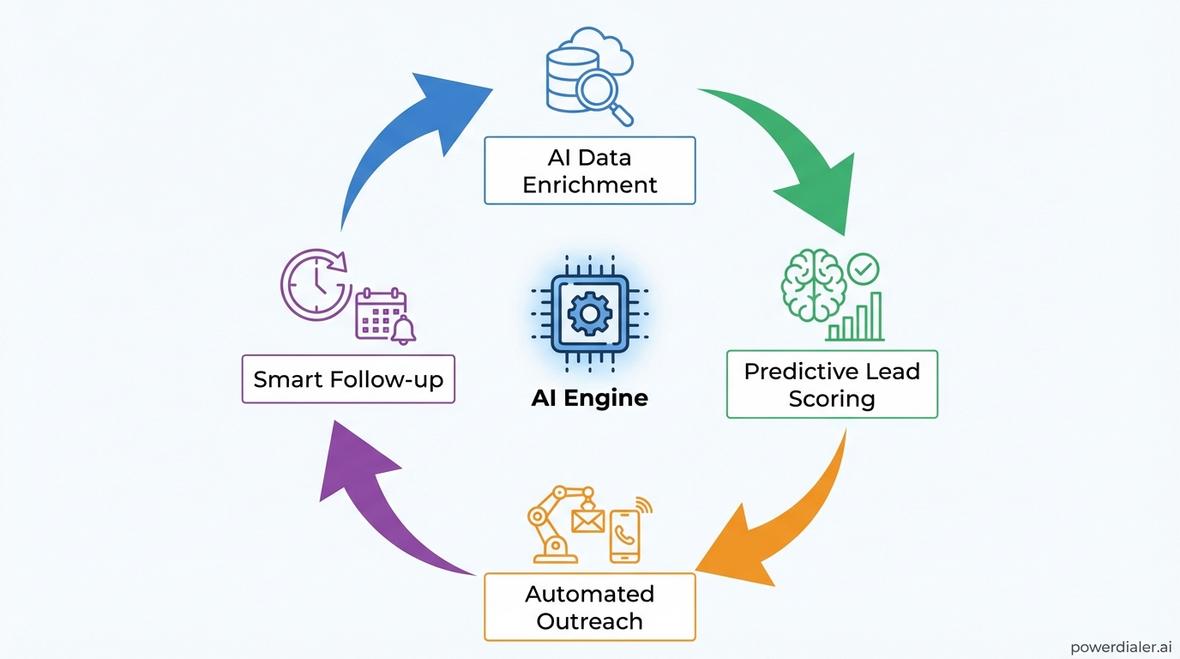
The core components of AI in sales prospecting include:
- Data Enrichment: AI automatically gathers and enhances lead information from multiple sources, creating comprehensive prospect profiles.
- Predictive Lead Scoring: Machine learning algorithms analyze historical data to identify which prospects are most likely to convert.
- Automated Outreach: AI-driven systems initiate personalized contact through multiple channels at optimal times.
- Smart Follow-up: Intelligent scheduling and sequencing ensure prospects receive timely, relevant communications.
Key Benefits of Using AI for Sales Prospecting
Implementing AI in your prospecting workflow delivers measurable advantages that directly impact your bottom line. HubSpot's State of Marketing report reveals AI-personalized outbound campaigns achieve 32% higher response rates than manual efforts, demonstrating the tangible value of this technology.
Increased Efficiency and Time Savings
Sales reps spend an average of 21% of their day writing emails and 17% entering data into CRM systems. AI eliminates these time-consuming tasks by automating data entry, email personalization, and follow-up scheduling. This allows your team to focus on high-value activities like building relationships and closing deals.
Improved Lead Quality and Conversion Rates
AI-powered lead scoring uses predictive analytics to evaluate prospects based on their likelihood to convert. By analyzing firmographic data, behavioral signals, and engagement patterns, AI helps prioritize leads that deserve immediate attention. This targeted approach results in higher conversion rates and more efficient resource allocation.
Enhanced Personalization at Scale
Modern buyers expect personalized experiences, but delivering customized outreach to hundreds of prospects manually is impossible. AI analyzes prospect data to generate personalized messaging that resonates with individual pain points, industry challenges, and business objectives all at scale.
Data-Driven Decision Making
AI systems provide actionable insights into what's working and what isn't in your prospecting efforts. From optimal contact times to most effective messaging, these insights enable continuous optimization of your sales process. Tools like analytics and reporting features help track key performance indicators and coach your team to success.
How to Implement AI in Your Sales Prospecting Strategy
Successfully integrating AI into your prospecting workflow requires a structured approach. Follow these steps to maximize the impact of AI on your sales operations.
Step 1: Assess Your Current Prospecting Process
Before implementing AI tools, conduct a thorough audit of your existing prospecting workflow. Identify bottlenecks, time-consuming manual tasks, and areas where your team struggles most. Common pain points include:
- Hours spent on manual dialing and leaving voicemails
- Inconsistent follow-up sequences
- Poor lead prioritization
- Lack of personalization in outreach
- Limited visibility into team performance
Document these challenges as they'll guide your AI tool selection and implementation strategy.
Step 2: Choose the Right AI-Powered Prospecting Tools
Not all AI tools are created equal. Select solutions that address your specific challenges and integrate seamlessly with your existing tech stack. Essential features to look for include:
- CRM Integration: Ensure the tool syncs with your existing CRM integrations like Salesforce, HubSpot, or Apollo.
- Multi-Channel Outreach: Support for phone, email, and social media prospecting.
- Intelligent Dialing: Features like power dialer or parallel dialer capabilities to maximize connect rates.
- AI Coaching: Real-time guidance and AI sales coaching to improve rep performance.
- Analytics Dashboard: Comprehensive reporting on prospecting metrics and team performance.
Step 3: Set Up AI-Powered Data Enrichment
Quality data is the foundation of effective AI prospecting. Implement data enrichment tools that automatically append missing information to your lead records, including:
- Company size and revenue
- Technology stack and tools used
- Recent company news and funding rounds
- Decision-maker contact information
- Social media profiles and activity
This enriched data enables more accurate lead scoring and personalized outreach. AI systems continuously update this information, ensuring your database remains current and actionable.
Step 4: Implement Predictive Lead Scoring
Train your AI system to identify high-value prospects by feeding it historical conversion data. The algorithm will learn patterns that indicate purchase intent, such as:
- Website behavior and content engagement
- Email open and click-through rates
- Social media interactions
- Company growth indicators
- Firmographic fit with your ideal customer profile
As the system processes more data, its predictions become increasingly accurate, allowing your team to focus efforts where they'll have the greatest impact. For specialized industries like B2B sales or financial services, tailored scoring models can be particularly effective.
Step 5: Automate Intelligent Outreach Sequences
Design multi-touch prospecting sequences that AI can execute automatically. Effective sequences typically include:
- Initial contact via preferred channel (phone, email, or LinkedIn)
- Follow-up emails with personalized value propositions
- Strategic phone calls at optimal times
- Social media engagement and connection requests
- Content sharing relevant to prospect's industry or role
AI determines the optimal timing and channel for each touchpoint based on prospect behavior and engagement patterns. Features like voicemail detection ensure your team doesn't waste time leaving manual messages.
Step 6: Leverage Conversational AI and Natural Language Processing
Modern AI tools can analyze sales conversations to provide real-time coaching and post-call insights. Conversational AI helps by:
- Transcribing and analyzing call recordings
- Identifying successful talk tracks and objection handling techniques
- Providing real-time prompts during live calls
- Flagging opportunities for upselling or cross-selling
- Measuring sentiment and engagement levels
This technology accelerates rep development and ensures consistent messaging across your team.
Best Practices for AI-Powered Sales Prospecting
To maximize the effectiveness of AI in your prospecting efforts, follow these proven best practices:
Maintain the Human Touch
While AI automates many tasks, successful prospecting still requires genuine human connection. Use AI to handle repetitive work and data analysis, but ensure your reps add personal touches to outreach. Share authentic stories, reference specific company initiatives, and demonstrate genuine interest in solving prospect problems.
Continuously Train and Refine Your AI Models
AI systems improve with feedback. Regularly review AI-generated lead scores, messaging recommendations, and call outcomes. Mark predictions as accurate or inaccurate to help the system learn. Update your ideal customer profile as your business evolves to ensure AI targets the right prospects.
Test, Measure, and Iterate
Treat AI implementation as an ongoing optimization process. A/B test different messaging approaches, outreach sequences, and contact strategies. Monitor key metrics such as:
- Connect rates and conversation duration
- Email open and response rates
- Meeting booking percentages
- Pipeline velocity and conversion rates
- Revenue attributed to AI-assisted prospecting
Use these insights to continuously refine your approach and maximize ROI.
Ensure Compliance and Ethical AI Use
As you scale AI-powered prospecting, maintain compliance with regulations like GDPR, CCPA, and TCPA. Ensure your AI systems:
- Respect do-not-call and unsubscribe preferences
- Maintain accurate data and consent records
- Provide transparency about AI use in communications
- Allow prospects to easily opt out of automated sequences
Ethical AI use builds trust and protects your company from legal risks.
Integrate AI Across Your Tech Stack
AI delivers maximum value when integrated throughout your sales technology ecosystem. Ensure your AI prospecting tools connect with your CRM, marketing automation platform, conversation intelligence software, and analytics tools. This creates a seamless flow of data and insights across your organization.
Real-World Applications of AI in Sales Prospecting
Understanding how to use AI for sales prospecting becomes clearer when examining practical applications across different scenarios and industries.
Account-Based Prospecting
For companies pursuing enterprise accounts, AI identifies multiple stakeholders within target organizations, maps reporting relationships, and tracks account-level engagement signals. This enables coordinated multi-threaded outreach that accelerates deal cycles.
High-Volume Outbound Campaigns
Sales teams conducting large-scale outbound prospecting use sales dialer technology powered by AI to maximize daily conversation volume. AI determines optimal call times, personalizes messaging, and automatically adjusts cadence based on prospect engagement.
Industry-Specific Prospecting
Different industries require tailored prospecting approaches. AI adapts strategies for sectors like healthcare, real estate, or pharma, incorporating industry-specific compliance requirements, terminology, and buying cycles into prospecting workflows.
Inbound Lead Qualification and Routing
AI doesn't only power outbound prospecting. It also instantly qualifies inbound leads, scores them based on fit and intent, and routes them to the appropriate sales rep. This ensures hot leads receive immediate attention while lower-priority prospects enter appropriate nurture sequences.
Measuring Success: Key Metrics for AI-Powered Prospecting
To evaluate the impact of AI on your prospecting efforts, track these critical metrics:
- Connect Rate: Percentage of calls that reach a live person (target: 15-20% improvement with AI)
- Conversation Rate: Percentage of connects that result in meaningful conversations
- Meeting Booking Rate: Percentage of conversations that convert to scheduled meetings
- Lead Response Time: Average time from lead creation to first contact attempt
- Pipeline Contribution: Dollar value of opportunities sourced through AI-assisted prospecting
- Cost Per Qualified Lead: Total prospecting costs divided by qualified leads generated
- Rep Productivity: Number of meaningful conversations per rep per day
Establish baseline metrics before implementing AI, then track improvements over time to demonstrate ROI and identify areas for further optimization.
Common Challenges and Solutions
While AI offers tremendous benefits, implementation isn't without challenges. Here's how to address common obstacles:
Challenge: Poor Data Quality
Solution: Implement strict data hygiene protocols and use AI-powered data enrichment tools to continuously update and verify contact information. Regularly audit your database and remove outdated or duplicate records.
Challenge: Rep Resistance to AI Adoption
Solution: Involve reps in tool selection, clearly communicate how AI will make their jobs easier (not replace them), and provide comprehensive training. Highlight early wins and success stories to build momentum.
Challenge: Over-Automation and Loss of Personalization
Solution: Use AI to handle research and administrative tasks while preserving human decision-making for message content and relationship building. Set guardrails that require human review before sending AI-generated communications.
Challenge: Integration Complexity
Solution: Choose AI tools with native integrations to your existing tech stack or robust API capabilities. Work with vendors who provide implementation support and technical resources.
Future Trends in AI-Powered Sales Prospecting
As AI technology continues to evolve, expect these emerging trends to shape the future of sales prospecting:
- Generative AI for Hyper-Personalization: Advanced language models will create truly unique, contextually relevant outreach for each prospect.
- Predictive Intent Signals: AI will identify buying intent earlier in the customer journey through behavioral pattern analysis.
- Voice AI and Conversational Bots: AI-powered voice agents will handle initial qualification calls, freeing reps for higher-value conversations.
- Visual Prospecting Intelligence: AI will analyze visual content like org charts, product screenshots, and company photos to gather prospecting insights.
- Ethical AI Frameworks: Industry standards will emerge to govern responsible AI use in sales, balancing effectiveness with privacy and transparency.
Staying ahead of these trends positions your organization to maintain a competitive advantage in an increasingly AI-driven sales landscape.
Frequently Asked Questions
How much does AI sales prospecting software typically cost?
AI-powered sales prospecting tools range from $50 to $300+ per user per month, depending on features and scale. Many providers offer tiered pricing with basic automation at lower price points and advanced AI capabilities in premium plans. Some tools charge based on usage metrics like number of calls or emails sent.
Can small sales teams benefit from AI prospecting tools?
Absolutely. AI levels the playing field, allowing small teams to achieve productivity levels previously only possible with large sales organizations. Many AI prospecting platforms offer small business and startup plans with affordable pricing and easy implementation.
How long does it take to see results from AI prospecting?
Most teams notice improvements in efficiency within the first few weeks of implementation. However, AI systems require 60-90 days of data collection to deliver highly accurate predictive insights and optimized workflows. Full ROI typically manifests within 3-6 months.
Does AI prospecting work for all industries?
AI prospecting delivers value across virtually all B2B industries, though implementation details vary. Industries with longer sales cycles and complex buying processes (like enterprise software or healthcare) often see particularly strong results. The key is customizing AI models to your specific market dynamics.
What skills do sales reps need to use AI prospecting tools effectively?
Reps don't need technical expertise, but they should be comfortable with technology and willing to learn new systems. Basic CRM proficiency and data literacy help. Most importantly, reps need strong fundamental sales skills AI enhances these abilities rather than replacing them.
Conclusion
Understanding how to use AI for sales prospecting is essential for any modern sales organization seeking to maximize efficiency and revenue growth. By implementing AI-powered data enrichment, predictive lead scoring, automated outreach, and intelligent follow-up systems, your team can dramatically increase productivity while improving prospect engagement. The statistics speak for themselves teams using AI for prospecting see significantly higher qualification rates, faster pipeline velocity, and improved response rates. Start by assessing your current process, selecting tools that integrate with your existing tech stack like those available at PowerDialer.ai, and following the best practices outlined in this guide. With thoughtful implementation and continuous optimization, AI will transform your prospecting from a time-consuming challenge into a competitive advantage.