
Understanding the Prospect Call: Your Gateway to Sales Success
The prospect call represents a critical moment in the sales cycle a live conversation where sales development representatives (SDRs) and account executives connect with potential customers to qualify interest, demonstrate value, and move deals forward. Unlike cold outreach or email campaigns, a prospect call offers real-time interaction, immediate objection handling, and the opportunity to build genuine rapport.
In 2026, the landscape of B2B sales conversations has evolved dramatically. With buyers receiving countless automated messages daily, the human touch of a well-executed prospect call has become more valuable than ever. According to Forrester Research: Sales Productivity and Call Efficiency Trends, sales teams that optimize their calling strategies see productivity gains of up to 47% compared to those relying solely on manual processes.
For sales professionals working in industries ranging from B2B sales to healthcare, financial services, and real estate, mastering the prospect call isn't optional it's essential. This comprehensive guide will walk you through proven strategies, technology enablers, and tactical frameworks that transform average prospect calls into revenue-generating conversations.
Pre-Call Preparation: Setting the Foundation for Success
Before your prospect call even begins, success is largely determined by your preparation. Top-performing SDRs understand that research and targeting are non-negotiable elements of effective prospecting.
Research and Target Your Ideal Customer Profile
Begin every prospect call with a clear understanding of who you're calling and why they matter to your business. Develop a detailed ideal customer profile (ICP) that encompasses firmographic data, pain points, buying triggers, and decision-making hierarchies. This foundational work ensures you're investing time in conversations with genuine potential.
Modern sales teams leverage multiple data sources LinkedIn, company websites, industry publications, and CRM enrichment tools to build comprehensive prospect profiles. Understanding your prospect's recent company announcements, competitive landscape, and industry challenges allows you to personalize your approach and demonstrate genuine interest rather than generic pitch delivery.
Craft Compelling Talk Tracks and Scripts
While spontaneity has its place, structured talk tracks provide guardrails that keep prospect calls focused and effective. Develop flexible scripts that include:
- Permission-based openers that respect the prospect's time
- Value propositions tailored to specific personas and industries
- Discovery questions that uncover pain points and priorities
- Objection responses for common pushback scenarios
- Clear next-step requests that advance the opportunity
Tools like the Talk Track Builder can help sales teams create customized scripts that resonate with specific buyer personas while maintaining conversational authenticity.
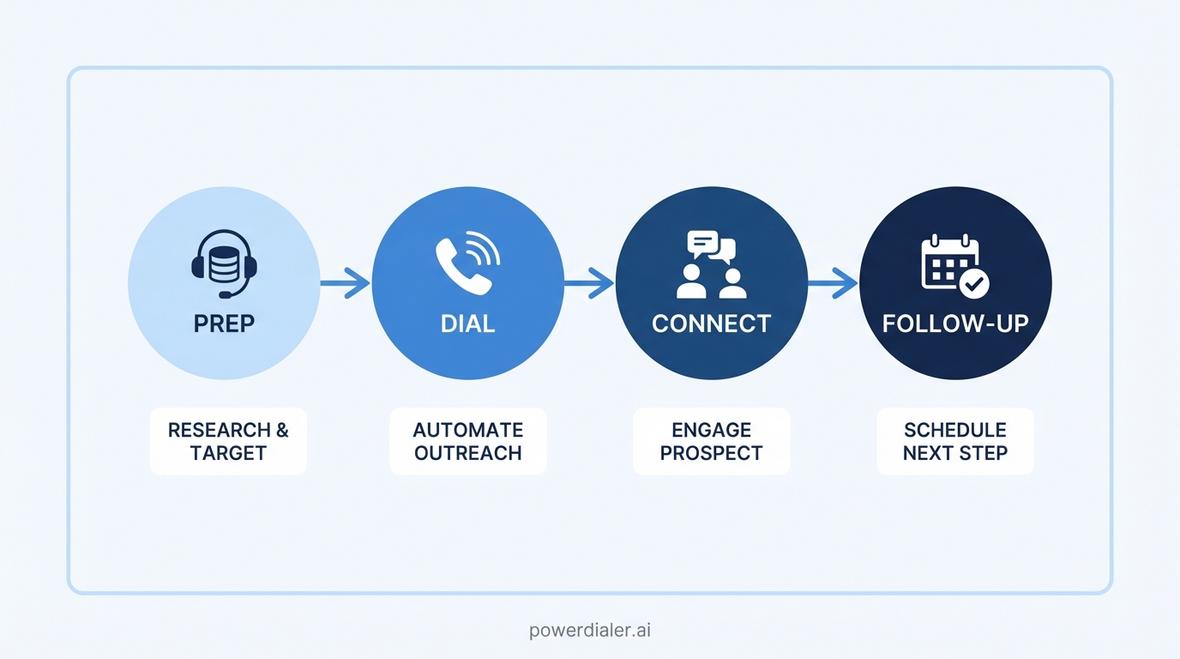
Automate Outreach: Leveraging Technology for Maximum Efficiency
Manual dialing wastes valuable selling time. Sales professionals spend an average of 15 hours per week on non-revenue-generating activities, with manual dialing accounting for a significant portion. This is where intelligent automation transforms prospect call productivity.
The Power Dialer Advantage
A power dialer automates the dialing process, connecting sales reps only to answered calls and eliminating the dead time associated with busy signals, disconnected numbers, and voicemails. This technology enables SDRs to have 3-4x more conversations per hour compared to manual dialing methods.
Unlike predictive dialers that may connect prospects before a rep is ready, power dialers maintain control and compliance while dramatically increasing efficiency. Features like local presence dialing, which displays caller IDs matching the prospect's area code, can improve answer rates by up to 400%.
Parallel Dialing: The Next-Level Breakthrough
For teams seeking even greater efficiency, parallel dialers simultaneously call multiple prospects, instantly connecting reps to whichever prospect answers first. This approach maximizes talk time while minimizing idle periods, making it particularly effective for high-volume outbound campaigns.
When evaluating dialing solutions, consider integration capabilities with your existing CRM. Native integrations with platforms like Salesforce, HubSpot, and Apollo ensure seamless data flow and eliminate manual data entry that slows down prospect call workflows.
Engage the Prospect: Techniques That Drive Conversations Forward
Once connected, the quality of your prospect call determines whether it advances to the next stage or ends in rejection. Engagement isn't about talking more it's about listening better and asking smarter questions.
The Discovery Questions Framework
Effective prospect calls follow a discovery methodology that uncovers needs, challenges, and buying motivation. The SPIN selling framework provides a structured approach:
- Situation questions: Understand the prospect's current state
- Problem questions: Identify pain points and challenges
- Implication questions: Explore the consequences of inaction
- Need-payoff questions: Help prospects articulate the value of solving their problem
This consultative approach positions you as a trusted advisor rather than a transactional vendor, building the foundation for long-term customer relationships.
Handling Objections with Confidence
Every prospect call encounters resistance. The difference between top performers and average reps lies in objection handling capability. Common objections include 'not interested,' 'send me information,' 'too expensive,' and 'already working with a competitor.'
Rather than viewing objections as rejection, treat them as requests for more information. Use the 'acknowledge, question, respond' framework to address concerns while maintaining rapport and forward momentum.
Follow-Up: Scheduling Next Steps That Stick
The prospect call doesn't end when you hang up it transitions into strategic follow-up that nurtures the relationship toward a decision. Research shows that 80% of sales require five or more follow-up contacts, yet most reps give up after just two attempts.
Cadence Optimization for Persistent Outreach
Develop a multi-touch sales cadence that combines prospect calls with emails, social touches, and value-added content. The optimal cadence balances persistence with respect, typically spanning 10-14 days with 8-12 touchpoints across multiple channels.
Automation tools can orchestrate these sequences while maintaining personalization at scale. Calendar integrations allow you to book next steps directly during the prospect call, reducing friction and improving show rates for discovery meetings and product demonstrations.
CRM Documentation: Your Future Self Will Thank You
Meticulous note-taking during and after prospect calls creates institutional knowledge that benefits your entire sales organization. Document discussion points, objections raised, competitive intelligence, and specific next steps with assigned ownership and deadlines.
This practice becomes especially valuable when deals involve multiple stakeholders or extended sales cycles common in B2B sales environments. Quality documentation enables seamless handoffs between SDRs and account executives while providing coaching opportunities for sales managers.
Analytics and Optimization: Data-Driven Prospect Call Improvement
What gets measured gets managed. Top-performing sales teams leverage analytics to continuously refine their prospect call strategies and identify improvement opportunities.
Key Metrics to Track
Monitor these critical KPIs to assess and improve prospect call performance:
- Connect rate: Percentage of dials resulting in live conversations
- Conversation rate: Percentage of connects that engage beyond initial greeting
- Qualification rate: Percentage of conversations identifying qualified opportunities
- Meeting set rate: Percentage of calls resulting in scheduled next steps
- Average call duration: Time spent in productive conversations
- Speed to lead: Time elapsed between lead creation and first contact
Platforms with built-in analytics and reporting provide visibility into these metrics at individual, team, and organizational levels, enabling targeted coaching and process optimization.
Call Recording and AI-Powered Coaching
Recording prospect calls (with proper consent and compliance) creates invaluable training resources. Modern AI sales coaching platforms analyze recorded conversations to identify successful patterns, flag areas for improvement, and provide personalized feedback to each rep.
This technology evaluates factors like talk-to-listen ratio, filler word usage, question quality, and objection handling effectiveness delivering insights that accelerate skill development far beyond traditional coaching methods.
Industry-Specific Prospect Call Strategies
While core principles apply universally, different industries require tailored approaches to prospect calls based on unique buyer behaviors, regulatory environments, and decision-making processes.
Financial Services: Building Trust Through Compliance
Prospect calls in financial services must balance persuasion with strict regulatory compliance. Financial products often require detailed disclosures, consent documentation, and careful language around guarantees and projections. Successful reps demonstrate deep product knowledge while maintaining transparency that builds the trust essential in this sector.
Healthcare: Navigating Complex Buying Committees
In healthcare sales, prospect calls typically involve multiple stakeholders with different priorities clinical staff focus on patient outcomes, administrators on cost containment, and IT on integration requirements. Effective prospecting identifies and maps these stakeholders, tailoring messaging to each perspective while orchestrating consensus.
Real Estate: Speed and Personalization Win Deals
The real estate industry operates on urgency and relationships. Prospect calls must happen quickly after lead generation research shows contact within five minutes increases conversion likelihood by 21x compared to waiting 30 minutes. Local market knowledge, personalized property recommendations, and immediate availability separate successful agents from the competition.
Common Prospect Call Mistakes to Avoid
Even experienced sales professionals fall into predictable traps that undermine prospect call effectiveness. Awareness of these pitfalls helps you avoid them.
Talking Too Much, Listening Too Little
The most common mistake is monopolizing the conversation with product features and company credentials. Research indicates top performers maintain a 43:57 talk-to-listen ratio, allowing prospects to articulate their needs while the rep guides the conversation with strategic questions.
Skipping the Permission Question
Launching directly into your pitch without confirming the prospect has time to talk demonstrates disrespect and immediately creates resistance. A simple 'Is now a good time for a brief conversation?' acknowledges their schedule and increases engagement likelihood.
Weak or Absent Call-to-Action
Every prospect call should conclude with a clear next step whether scheduling a demo, sending specific information, or arranging a follow-up conversation. Vague endings like 'I'll check back with you' surrender control and reduce advancement probability. Be specific about what happens next and when.
Building Your Prospect Call Technology Stack
The right tools multiply your effectiveness and enable scalability that manual processes cannot match. A comprehensive prospect call stack includes:
Core Technology Components
Dialing Platform: Whether you choose a power dialer, parallel dialer, or predictive dialer depends on your team size, call volume, and compliance requirements. Evaluate options based on features like voicemail detection, local presence dialing, and CRM integration depth.
CRM System: Your customer relationship management platform serves as the central hub for prospect data, activity tracking, and pipeline management. Native dialer integrations eliminate double data entry and ensure accurate activity logging.
Conversation Intelligence: AI-powered platforms that transcribe, analyze, and extract insights from prospect calls provide coaching opportunities and competitive intelligence that inform strategy refinement.
Lead Enrichment Tools: Data providers and enrichment platforms supplement basic contact information with firmographic details, technographic insights, and behavioral signals that enable more relevant, personalized conversations.
Compliance and Legal Considerations for Prospect Calls
Regulatory compliance isn't optional it's fundamental to sustainable prospect call operations. Violations can result in substantial fines and reputational damage that far outweigh any short-term gains.
TCPA and Consent Requirements
The Telephone Consumer Protection Act (TCPA) governs commercial calling in the United States, requiring prior express written consent for autodialed or prerecorded calls to cell phones. Understanding TCPA compliance guidelines and maintaining meticulous consent documentation protects your organization from costly litigation.
Call Recording Laws by State
Call recording regulations vary by jurisdiction, with some states requiring all-party consent while others permit one-party consent. Sales teams operating across state lines must understand and comply with the most restrictive applicable laws. Implementing clear disclosure statements at call initiation ensures compliance while building trust through transparency.
Advanced Prospect Call Techniques for Experienced Reps
Once you've mastered foundational skills, these advanced techniques can further differentiate your performance and results.
Multithreading: Expanding Your Sphere of Influence
Rather than relying on a single contact within target accounts, multithreading strategies build relationships with multiple stakeholders across the organization. This approach reduces single-point-of-failure risk, accelerates deal velocity through internal advocacy, and provides diverse perspectives on organizational priorities.
Referral Generation During Prospect Calls
Even when a prospect isn't personally qualified, they may know someone who is. Incorporating referral requests into your prospect call process especially with contacts who express interest but lack authority or budget can generate high-quality introductions that convert at rates 3-5x higher than cold outreach.
The Future of Prospect Calls: AI and Automation Trends
The prospect call landscape continues evolving rapidly as artificial intelligence and automation technologies mature. Forward-thinking sales organizations are already leveraging:
- AI-powered dialers that optimize calling times based on prospect behavior patterns
- Real-time conversation guidance that suggests responses during live calls
- Predictive analytics that score lead quality and prioritize outreach sequences
- Voice synthesis technology for personalized voicemail drops at scale
- Sentiment analysis that gauges prospect engagement and buying signals
These innovations don't replace human sales professionals they amplify their capabilities, handling repetitive tasks and data analysis while freeing reps to focus on relationship building and strategic thinking that drive revenue growth.
Frequently Asked Questions About Prospect Calls
What is the best time to make prospect calls?
Research indicates the highest connect rates occur during mid-morning (10-11 AM) and mid-afternoon (2-3 PM) on Wednesdays and Thursdays. However, optimal timing varies by industry, persona, and geography. Use data-driven tools to identify patterns specific to your target market.
Should I leave voicemails during prospect calls?
Voicemail strategy depends on your overall cadence. While voicemail return rates are typically low (under 5%), they serve as touchpoints that build familiarity and credibility. Keep messages under 20 seconds, clearly state your value proposition, and provide a specific reason to call back. Alternatively, consider automated voicemail drop features that save time while maintaining consistency.
How many prospect calls should I make before scheduling a meeting?
There's no universal answer it depends on your qualification criteria and the prospect's engagement signals. Focus on conversation quality rather than arbitrary call counts. If a prospect demonstrates clear need, authority, budget, and timeline, schedule the meeting. If key qualification criteria remain unclear, additional discovery calls may be necessary before advancing.
How can I improve my prospect call connect rates?
Improve connect rates through local presence dialing, optimal timing based on prospect behavior, varied calling patterns that avoid spam flagging, and maintaining positive caller ID reputation. Additionally, multi-channel warming through email and LinkedIn before calling can increase answer likelihood when prospects recognize your name.
Conclusion
Mastering the prospect call requires deliberate preparation, strategic technology adoption, continuous skill development, and data-driven optimization. By implementing the frameworks and techniques outlined in this guide from comprehensive pre-call research to AI-powered coaching and analytics sales professionals can dramatically increase their conversion rates and revenue impact. The prospect call remains a cornerstone of B2B sales success, and those who invest in excellence at this critical touchpoint will consistently outperform their competition. Whether you're an individual SDR looking to improve personal performance or a sales leader building organizational capability, prioritizing prospect call quality delivers measurable returns that compound over time.