Outbound sales prospecting tactics are the backbone of every successful sales development program. For SDRs and BDRs, mastering these tactics can mean the difference between hitting quota and missing it entirely. While inbound leads come and go, a strong outbound sales process gives your team predictable pipeline growth and full control over lead generation.
Whether you’re an experienced sales development representative or a new SDR learning the ropes, this guide will walk you through proven outbound sales prospecting tactics that build trust, fill your calendar, and move qualified leads deeper into your sales funnel.
Why Outbound Sales Prospecting Still Works
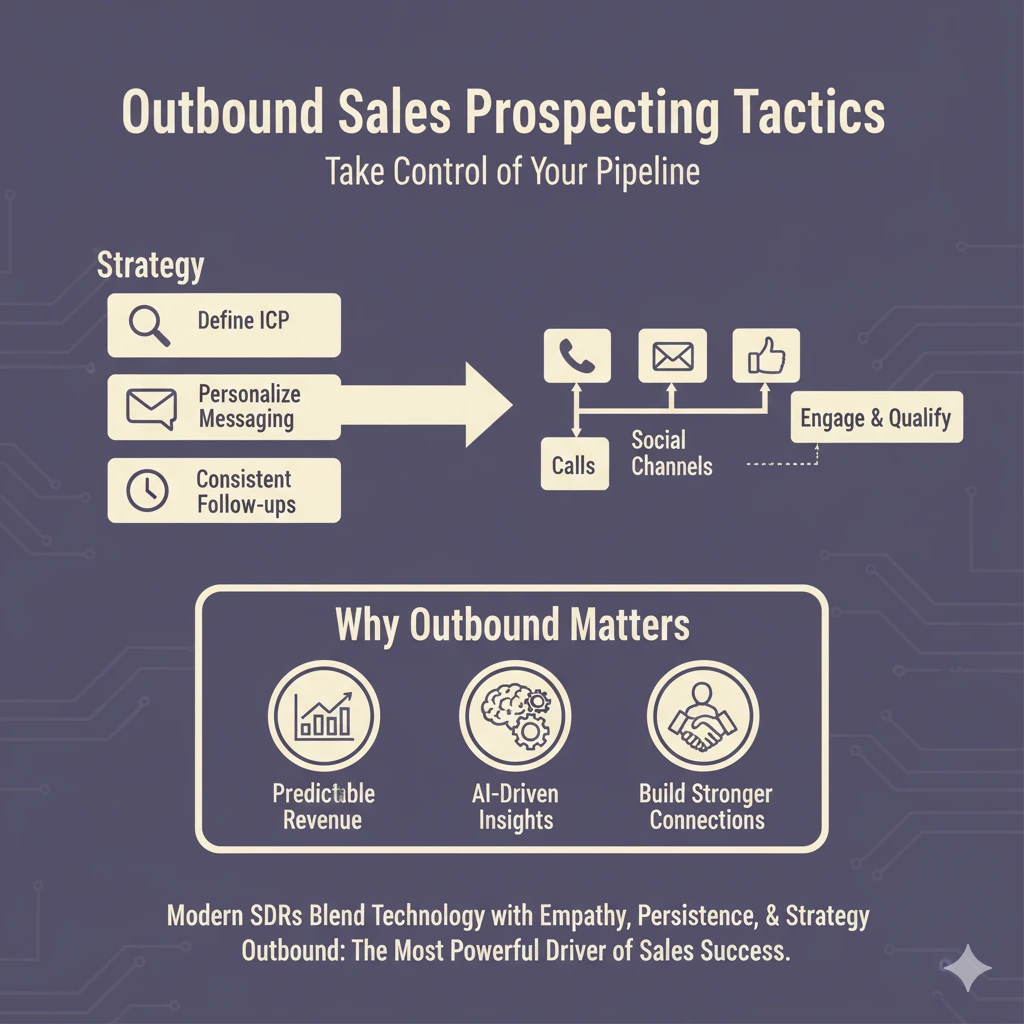
The debate between inbound and outbound selling has existed for years, but the truth is, outbound still wins when you need immediate, targeted results. Unlike inbound marketing, which depends on content or SEO to attract traffic, outbound sales puts control directly in your hands.
When done right, outbound prospecting lets SDRs reach specific industries, job titles, and company sizes that fit their ideal customer profile (ICP). This focus improves the quality of conversations and keeps your sales pipeline building consistent throughout the year.
According to recent sales data, teams using structured outbound cadences see 2.5× higher connect rates and 40% faster lead qualification compared to unstructured outreach. Outbound works because it’s human, proactive, and measurable, everything predictable revenue depends on.
Consistency, personalization, and data-driven strategies keep outbound relevant even in 2025 and beyond. The key lies in how you execute your outbound sales prospecting tactics, not just how many dials you make.
Understanding the Outbound Sales Prospecting Process
What Is Outbound Prospecting?
Outbound prospecting is the process of identifying, reaching, and qualifying potential customers who haven’t interacted with your brand yet. The goal isn’t just to sell, it’s to start conversations.
Sales Development Representatives (SDRs) and Business Development Representatives (BDRs) play a crucial role here. Their job is to connect with decision-makers through emails, cold calls, and LinkedIn, qualify them using outbound lead qualification criteria, and hand warm leads over to account executives.
This approach fuels continuous lead generation processes, ensuring your pipeline never runs dry.
Outbound vs. Inbound Sales Prospecting
Inbound prospecting relies on prospects coming to you, through SEO, ads, or webinars. Outbound, on the other hand, means reaching out first.
Outbound works best for B2B prospecting methods that target specific companies or enterprise accounts. When you know your ICP well, outbound becomes a high-return channel because it directly addresses customer pain points rather than waiting for them to find you.
Outbound also allows immediate testing of messaging, faster feedback loops, and tighter control over revenue forecasting, all crucial for SDRs in fast-moving industries.
Common Challenges in Outbound Sales
Every SDR faces roadblocks:
- Low response rates caused by generic emails and non-personalized messages.
- Poor data accuracy from outdated contact lists or incomplete CRM entries.
- Ineffective messaging that talks about your product instead of solving the customer’s problem.
Overcoming these requires precision, empathy, and technology. By adopting the right outbound sales prospecting tactics, SDRs can overcome these challenges and connect more effectively with qualified prospects.
Step-by-Step Outbound Prospecting Tactics That Work
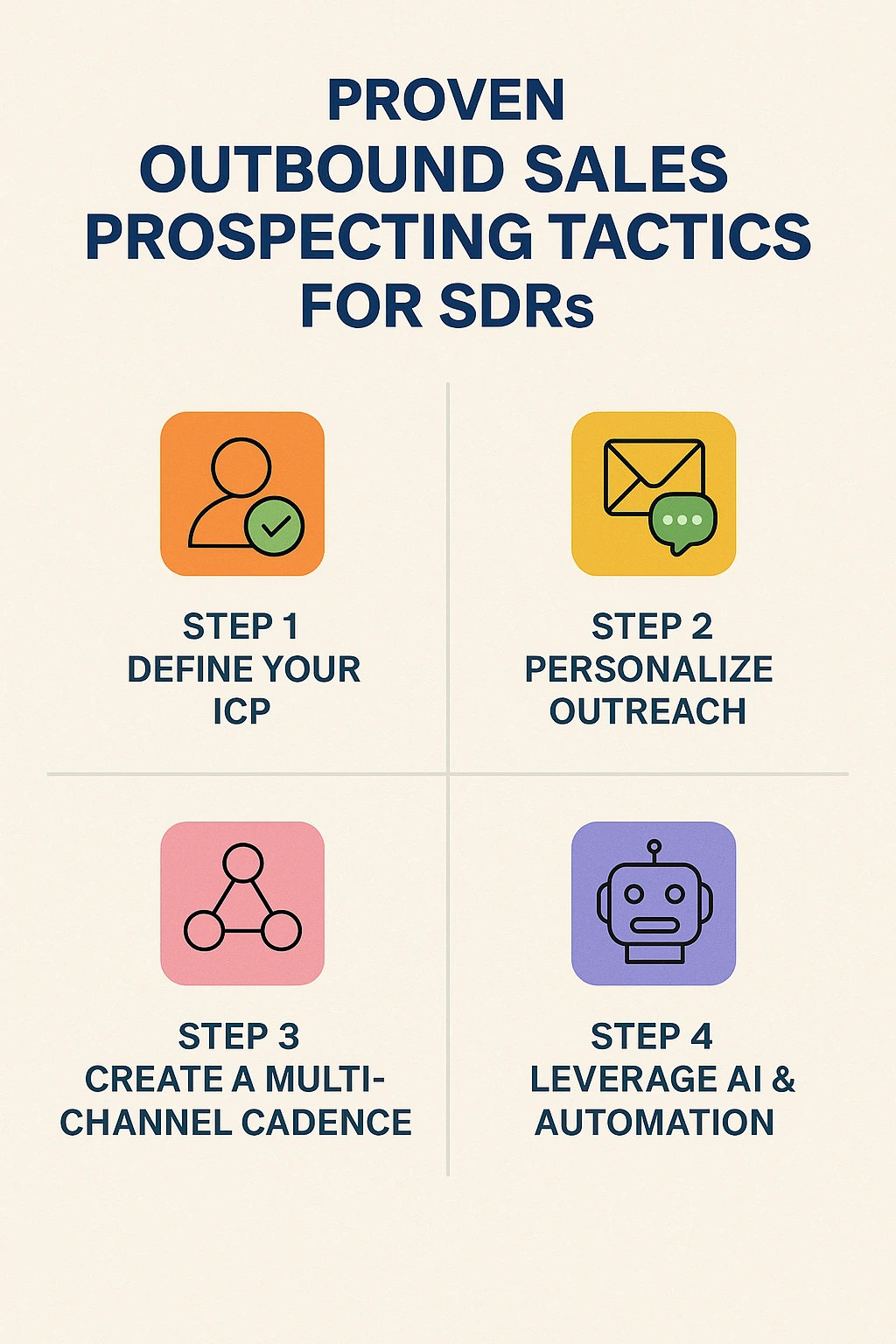
Step 1: Define and Refine Your Ideal Customer Profile (ICP)
A successful sales prospecting framework starts with clarity, knowing exactly who you want to reach. Your ICP (ideal customer profile) is not just a job title or industry; it’s a detailed description of your best-fit customers based on demographics, firmographics, and behavioral traits.
Use data sources like LinkedIn Sales Navigator, Apollo.io, and ZoomInfo to validate your ICP. Look at your most successful clients and identify patterns: revenue size, decision-maker roles, and buying triggers.
By targeting accurately, your SDR outreach becomes sharper, your cold calls more relevant, and your conversion rates higher. A refined ICP is the engine of efficient outbound sales prospecting.
Step 2: Personalize Every Outreach
Generic messages don’t convert. Personalization shows effort, and effort builds trust. Start by referencing the prospect’s company goals, recent announcements, or shared connections.
Use CRM insights, LinkedIn activity, and website behavior to craft personalized messages. For example:
“Hi Sarah, I noticed your team recently expanded into the Midwest market. Many growing logistics firms face call response delays during expansion. I had an idea that might help.”
This type of cold outreach personalization immediately signals relevance and earns you attention. Combine emotional triggers (like empathy) with logical value (like ROI or time savings) to maximize engagement.
Step 3: Create a Consistent Multi-Channel Cadence
The most effective SDRs don’t rely on one channel. They create a multi-channel prospecting cadence that combines email, phone, LinkedIn, and SMS for balanced outreach.
Here’s a proven outbound cadence sequence example:
- Day 1 – Personalized introduction email
- Day 2 – Cold call with value hook
- Day 4 – LinkedIn connection + message
- Day 6 – Short follow-up email
- Day 9 – Call + voicemail
- Day 12 – Case study share
- Day 15 – Final touch with humor or creativity
Repetition builds familiarity. Prospects often respond only after 5–7 touches, so persistence matters.
Step 4: Leverage AI and Automation Tools
Modern SDRs succeed by blending human skill with technology. AI-driven sales automation tools like Outreach.io, Lavender, Apollo, and PowerDialer.ai streamline repetitive tasks, sequencing emails, scheduling follow-ups, and logging activities.
AI can even analyze sentiment and suggest the best time to reach out. This combination of intelligence and automation ensures SDRs spend less time on admin work and more on real conversations.
Pro Tip: Don’t over-automate. Let AI handle the busywork, but keep personalization and emotional intelligence human.
Book a demo with PowerDialer.ai to see how AI-driven dialing can double your connection rate and free up more time for high-value interactions.
Step 5: Use Data to Improve Conversion
Data is your best coach. Track open rates, reply rates, and connect-to-meeting ratios across your campaigns. Review analytics weekly to identify what’s working and where drop-offs occur.
Use A/B testing for subject lines, call openings, and message lengths. For instance, short 4-line emails often outperform long-form pitches.
Tools like Gong, Refract, and PowerDialer.ai can record and analyze call performance, helping SDRs refine tone, pacing, and objection handling. This data-driven iteration builds a smarter outbound machine that improves month after month.
Step 6: Master Cold Calling
Cold calling is still one of the most direct outbound sales strategies in the world. It cuts through noise and lets SDRs create instant human connection.
Start calls with curiosity rather than pitching.
Example:
“Hi Alex, quick one, are you still leading the expansion into enterprise accounts? I’ve seen a few teams solve outbound volume challenges differently. Mind if I share what worked?”
Use open-ended questions, stay calm through objections, and always aim for micro-commitments like booking a discovery call, not closing a deal.
Strong cold calling tactics rely on tonality, timing, and genuine interest, not scripts.
Step 7: Follow Up Strategically
Most deals are won after the fifth touch. Effective follow-up strategies separate great SDRs from average ones.
Follow up with value, not desperation. Send relevant resources, case studies, testimonials, or market insights, instead of “just checking in.” Space your follow-ups wisely, alternating between channels to stay visible but not pushy.
A good rhythm: every 2–3 days for the first week, then weekly for three weeks. When a lead goes cold, recycle them into nurture campaigns and revisit later with new offers or product updates.
Advanced Outbound Sales Prospecting Tactics for SDRs
Build Trust Early with Value-Driven Outreach
In modern B2B prospecting methods, trust is currency. Share educational content, not just sales pitches. Send short videos, relevant reports, or a quick ROI calculator that shows you understand their business.
The earlier you offer genuine value, the faster prospects view you as an advisor, not a salesperson.
Monitor Buyer Intent Signals
Today’s top SDRs use platforms like 6sense or Bombora to identify buyer intent signals, data showing which companies are actively researching your type of solution. Prioritize outreach to these warm leads to improve conversion efficiency.
Timing matters. Engaging a prospect the moment they start researching increases win probability dramatically.
Collaborate with Marketing and AE Teams
Outbound success depends on alignment. Work closely with marketing to refine your ICP and messaging. Sync with AEs to ensure smooth lead handoffs.
Regularly review call recordings together, share feedback, and build a unified outbound playbook. This collaboration shortens cycles, eliminates friction, and helps SDRs learn faster.
Tools Every SDR Should Use for Outbound Prospecting
Data & Lead Generation
Use tools like ZoomInfo, Apollo, Clay, and Cognism for accurate data enrichment and segmentation.
Outreach & Sequencing
Platforms such as Outreach.io, SalesLoft, and HubSpot Sequences manage outreach automation and ensure every prospect gets timely follow-ups.
AI Coaching & Analytics
Gong, Chorus, Refract, and PowerDialer.ai analyze call quality and help SDRs improve through personalized coaching.
CRM & Reporting
Reliable CRMs like Salesforce, HubSpot, and Pipedrive keep all activity logged, ensuring transparency across your outbound team.
Measuring Success in Outbound Prospecting
Key SDR Metrics to Track
- Daily activity: dials, emails, and social touches
- Connect-to-meeting ratio: measures efficiency
- Reply rates & conversions: gauge message quality
- Pipeline created: actual business impact
How to Continuously Improve Your Tactics
Conduct weekly pipeline reviews, evaluate conversion trends, and share learnings across the team. Roleplay with peers to refine objection handling and closing.
Sales excellence isn’t built overnight, it’s shaped through feedback, adaptation, and repetition.
Common Mistakes SDRs Make in Outbound Prospecting
Avoid these pitfalls to maximize outbound ROI:
- Sending generic, non-personalized emails
- Failing to research prospects before calls
- Neglecting follow-ups or giving up too early
- Poor CRM hygiene, leading to lost data
Top SDRs treat every interaction as an opportunity to learn and iterate. Precision beats volume every time.
Conclusion: Mastering Outbound Sales Prospecting
Outbound sales prospecting tactics thrive on persistence, personalization, and data-driven execution. SDRs who combine emotional intelligence with structured workflows will always outperform those who rely on luck or scripts.
The outbound sales process isn’t dying, it’s evolving with technology, analytics, and AI. Stay consistent, stay human, and let automation amplify your impact.
Book a demo with PowerDialer.ai to automate your dialing, analyze your outreach, and scale your outbound performance instantly.
FAQs
Q1: What is the most effective outbound sales prospecting tactic?
Personalized multi-channel outreach combining calls, emails, and social touches delivers the strongest conversion rates.
Q2: How can SDRs improve outbound response rates?
Focus on personalization, accurate ICP targeting, and consistent follow-ups using relevant content.
Q3: How often should SDRs follow up with prospects?
Follow up 5–7 times across different channels before pausing contact.
Q4: What tools help automate outbound prospecting?
Apollo, Outreach, SalesLoft, and PowerDialer.ai automate email sequences, calling, and analytics.
Q5: How long does it take to see results from outbound prospecting?
With consistent outreach and testing, most SDRs see measurable results within 30–60 days.