Sales pipeline management is the core of any successful sales organization. It allows sales teams to track prospects, understand performance, and optimize every interaction from first touch to the final deal. In this fast-moving, data-driven market, companies using strong sales pipeline management practices close more deals, forecast revenue more accurately, and scale faster.
Be it an up-and-coming startup or a well-established enterprise, learning how to structure, track, and optimize your pipeline is critical. This guide will walk through each stage of sales pipeline management, the best tools to use in each, and provide actionable steps toward ramping up efficiency through automation and analytics.
What is Sales Pipeline Management?
Sales pipeline management is essentially the organization and tracking of all your potential deals as they move through clearly defined stages in the sales pipeline-from lead generation to close. It lets you see how each opportunity moves along in the process to help a team make smarter decisions based on real-time data.
An effective pipeline gives your team visibility into every opportunity, nurtures leads, and predicts future revenue. With better sales funnels management, you are able to zero in on high-value deals, shorten sales cycles, and eliminate bottlenecks before they slow down conversions.
Key Benefits for Sales-First Platforms
- Improved forecasting: Precise sales forecasts guarantee predictable growth.
- Higher conversion rates through the understanding of where drop-offs happen and what to do to increase engagement.
- Increased productivity: sellers can sell more and spend less time doing manual work.
- Stronger pipeline visibility: Track every stage clearly on visual dashboards.
- Informed decisions: Make data-driven moves in the use of sales performance analytics.
Success or failure of the modern B2B sales pipeline largely depends on how well the teams can manage and optimize their sales data.
Why Modern Sales Platforms Need Strong Pipeline Management
Aligning Sales, Marketing, and Operations
Modern sales platforms integrate marketing, sales, and customer success into a single ecosystem. Proper CRM pipeline management ensures leads are smoothly passed from marketing to sales and tracked to conversion. This builds accountability and eliminates information silos that slow growth.
It allows all departments to track opportunities, because a synced system allows tracking throughout the customer life cycle, from first contact all the way to post-sale engagement.
From Manual Tracking to Automation
Manual spreadsheets once ruled the sales world, but they don't scale anymore. Sales automation tools like PowerDialer.ai handle these routine tasks for follow-ups, call logging, and data entry. Automation saves not only time but ensures that it is done correctly. Teams develop actionable insights through pipeline tracking and reporting, enabling them to pay more attention to meaningful conversations and deals that truly matter.
Book a free demo with PowerDialer.ai to see how automation can increase your connect rates and reduce deal cycles.
Stages of a Sales Pipeline
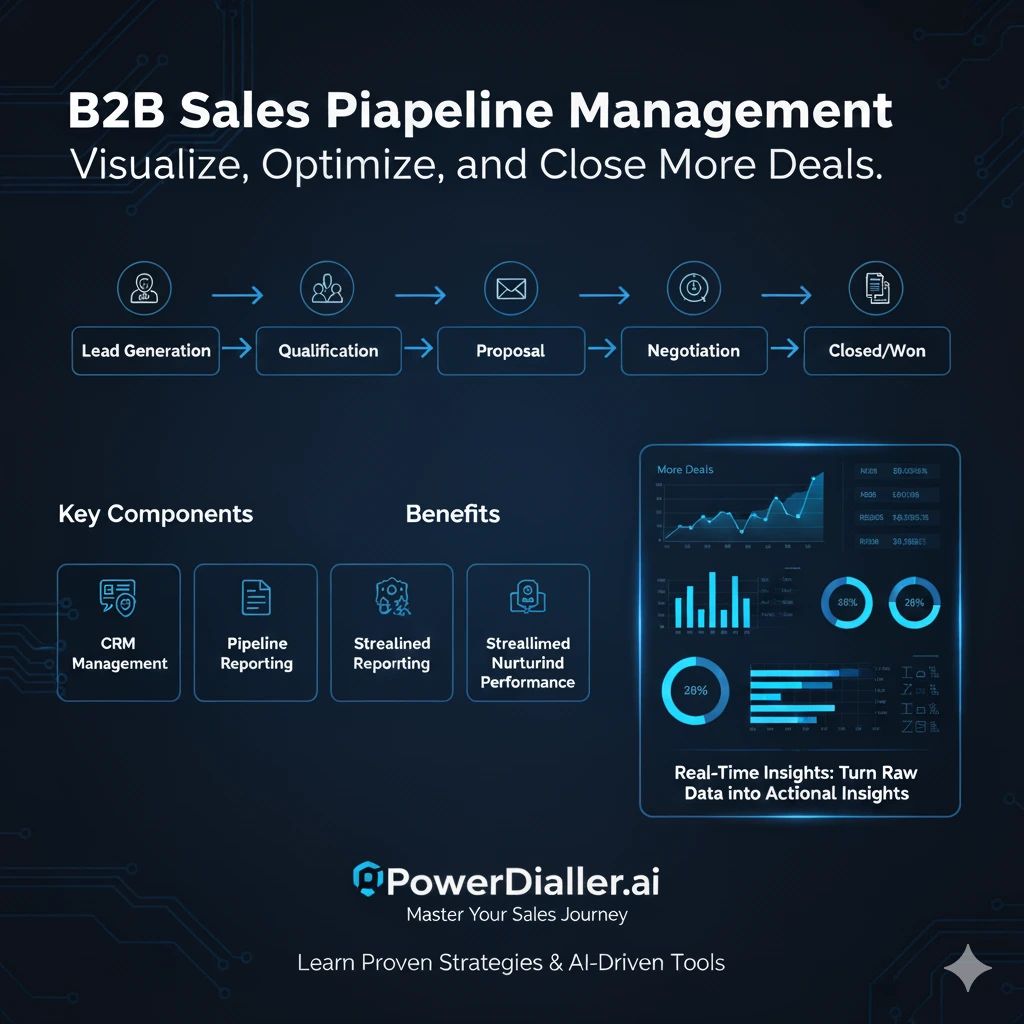
Every sales process is unique, but most pipelines follow five key stages:
Stage 1 - Lead Generation
It's the stage of prospect hunting: through inbound channels-content, SEO, social-but also with outbound campaigns to capture leads via calls, emails. For this, the sales pipeline software will help you automate lead capturing, lead scoring, and tracking in order to ensure that only qualified prospects pass into your funnel.
Stage 2 - Qualification
Qualification determines whether a lead fits your ICP. Pipeline management in the CRM enables sales teams to scan through data fast and assign a priority score for each account, focusing reps' time on those prospects with the highest likelihood to convert.
Stage 3 - Meeting or Demo
Here, the representative engages prospects through calls or demos. The aim is to identify pain points and align your solution's value. Tools like PowerDialer.ai integrate call tracking and analytics for you to measure call effectiveness and improve performance through coaching insights.
Stage 4 - Proposal & Negotiation
At this stage, speed and clarity are vital. Automated deal tracking software helps the sales teams send proposals much faster, set reminders, and manage feedback loops without losing track of communication.
Stage 5 - Closed-Won or Lost
The final step is when either the deal is won or lost. Analyze through sales performance analytics what led to the success, based on the outcomes. Review objections for lost deals and refine strategies to optimize the sales process.
Core Components of Sales Pipeline Management
CRM and Sales Platform Integration
The core of any scalable B2B sales pipeline is CRM. Tools such as HubSpot, Salesforce, or Zoho keep all your lead, call, and note data in one place. Integrated systems enhance collaboration, support revenue growth, and improve tracking accuracy.
Real-Time Analytics & Dashboards
A sales pipeline dashboard provides instant visibility into your team's performance. By tracking pipeline metrics such as conversion rates, deal velocity, and forecast accuracy, you'll be able to see where opportunities stall and where your team excels.
Pipeline Hygiene and Maintenance
A clean pipeline means fewer surprises, and regular removal of inactive leads, contact information updates, and deal progress verification will keep your sales forecasting accurate and actionable.
Best Practices for Effective Sales Pipeline Management
1. Standardize Sales Stages
Clearly define each of your sales pipeline stages. Consistency will ensure reliable data for reporting and forecasting.
2. Focus on High-Intent Leads
Identify which leads are most likely to convert using lead scoring and behavioral insights. It enhances conversion rate optimization, ensuring maximum rep efficiency.
3. Automate Repetitive Tasks
Eliminate manual work using sales automation tools. Automate follow-up and reminders so reps can focus on the relationship instead of data entry.
Automate more efficiently and bring more visibility to pipelines with PowerDialer.ai; book a demo today!
4. Measure and Review Regularly
Deal velocity monitors momentum and further fine-tunes sales strategies. Weekly pipeline reviews uncover problems well before they are reflected in the revenue.
Tools and Software for Modern Pipeline Management
Leading CRM Platforms
CRMs like Salesforce, HubSpot, Pipedrive, and Zoho remain core to CRM pipeline management. They centralize customer data, track communications, and provide performance analytics.
AI-Powered Sales Tools
Tools like PowerDialer.ai, SalesRoleplay.app, Gong, Outreach, and OpenMic AI use AI to automate engagement, analyze conversations, and guide reps toward better performance.
Pipeline Visualization Tools
This enables intuitive tracking and reporting of the pipeline through Kanban-style dashboards, heat maps, and forecasting charts to help managers make quicker and more effective decisions.
Key Metrics to Track in Your Sales Pipeline
- Conversion Rate: This is the percentage of leads that move through the different stages.
- Average Deal Size: Determines revenue potential.
- Sales Velocity: This measures the speed at which deals are moved from lead to close.
- Pipeline Value & Coverage Ratio: This indicates whether the existing opportunities at hand will be sufficient to reach the targets.
- Activity Metrics: Monitors daily outreach and follow-up volume.
Tracking these pipeline metrics will provide visibility into performance and support better decisions around revenue growth.
Common Sales Pipeline Challenges and How to Fix Them
Even the best sales organizations struggle to manage their sales pipelines. Data gaps, inconsistent tracking, and errors in forecasting block growth many times. Identifying those issues early keeps pipelines healthy and revenue growth consistent.
1. Inconsistent Data Entry
The major pains that come along with CRM pipeline management have to do with poor data hygiene: when reps forget to log their calls, update deal stages, or record notes, visibility gets disrupted and pipeline tracking and reporting go wrong.
How to Fix It:
Automate data entry into your CRM with sales automation tools, which log activities automatically after every call or email. Other software, such as PowerDialer.ai, can even sync contact information, call outcomes, and meetings in real time. That means each update is given complete accuracy, and so does your sales forecasting.
2. Poor Forecast Accuracy
Unreliable forecasting is the result of undated sales data, or when intuition alone leads the way. Inaccurate predictions lead to a failure to meet quotas and poor resource allocation.
How to Fix It:
Leverage historical performance data and AI-driven forecasting models to forecast future outcomes. Predictive analytics can identify patterns in stages of your sales pipeline and highlight the most probable deals that will close. Blending automation with human oversight enables managers to make educated, evidence-based decisions.
3. Poor Conversion at Mid-Funnel
Most leads enter the pipeline and never get to the last stage. This is due to weak lead nurturing, poor timing of follow-ups, or misaligned messaging in demos and proposals.
How to Fix It:
Encourage engagement through personalized outreach and better optimization of the sales process. Apply opportunity tracking and sales performance analytics to understand where leads fall off. Refine demo scripts, emphasize value propositions, and time follow-ups relative to prospect behavior signals. AI tools can even suggest the best moments in time for re-engagement with stalled leads.
Future Trends in Sales Pipeline Management: 2025 and Beyond
It is data intelligence, automation, and personalization that will shape the next generation in sales pipeline management. Companies embracing these kinds of innovations will have a distinctive competitive advantage.
1. Predictive Analytics
Artificial intelligence has now empowered teams to predict the success of deals with remarkable accuracy. Predictive models analyze lead quality, frequency of engagement, and deal velocity in an attempt to project which opportunities are most likely to convert.
The insights here help sales managers to focus their resources on high-value accounts, optimize resource allocation, and refine messaging. Moving ahead, predictive analytics will form the heart of enhancing conversion rates and long-term revenue growth.
2. Revenue Intelligence Tools
Modern sales ecosystems use revenue intelligence to collect and interpret the data from multichannel, calls, e-mails, CRMs, and social interactions. Such systems marry automation with human judgment to find hidden patterns in performance.
Integrated sales performance analytics enable the leaders to see deal health, rep productivity, and forecast accuracy for a 360-degree view. This ensures faster decision-making, better coaching, and scalable success across the organization.
3. Multi-Channel Pipeline Engagement
Today's buyers interact with brands on multiple touchpoints-voice, email, SMS, and chat. Future-ready sales pipeline software connects all of these into one unified sales pipeline dashboard.
Because of this integration, no conversation will get lost; pipeline visibility will be improved, and teams can deliver consistent experiences. In 2025 and beyond, multi-channel engagement will define the most effective and customer-centric sales teams.
How to Choose the Right Sales Pipeline Software
Finding the right software for sales pipeline management is highly critical to building a scalable, efficient, and transparent sales operation. It should combine flexibility, automation, and strong reporting features.
1. Scalability and Customization
Your software should grow with your business. Seek out tools that allow you to customize sales pipeline stages, workflows, and reporting fields yourself-without heavy development work. Whether it's 10 deals or 10,000, the platform should scale up easily with the size of the team and volume of sales.
The system also provides customizable dashboards, permission settings, and integration options to make it adaptable to your unique sales process optimization needs.
2. Integration Capabilities
Your pipeline software should integrate well with other systems such as CRM, marketing automation tools, dialers, and analytics dashboards. Integrating this keeps pipeline tracking and reporting aligned and prevents data fragmentation across tools.
It auto-logs the call, updates contact information, and builds analytical views around call performance within one place if, for example, PowerDialer.ai is integrated with your CRM. This stops redundant manual work and increases team efficiency.
3. Reporting and Analytics
Additionally, strong analytics and visual reports support progress monitoring and spotting areas of improvement. Be sure to look out for the provision of real-time dashboards, pipeline heatmaps, and the ability to export data reports.
Equipping managers with analytics for sales performance and trend insights allows them to make accurate forecasts and better strategic decisions.
Implementing a Sales Pipeline Management System
Of course, getting a great sales pipeline management system up and running requires some planning, alignment with the team, and continuous improvement. Here's how to make the rollout go smoothly.
Step 1: Map Your Sales Process
Start by mapping all of your sales flow. Find out which stage leads are coming into your funnel, on which triggers, and what KPIs define each stage as such. Mapping this process out gives clear insights into the management of the sales funnel and avoids ambiguity between different departments.
Visualize each stage of the lifecycle, from lead capture to close, using flowcharts or CRM templates that ensure every stage is aligned with quantifiable business objectives.
Step 2: Define Stages and KPIs
Clearly define the entry and exit criteria for each stage of the sales pipeline. For example, a lead may only move from "Qualified" to "Proposal Sent" after a discovery call with confirmation of budget.
Next, define the actionable KPIs: deal velocity, conversion rate, and pipeline coverage ratio are good metrics. These pipeline metrics ensure consistency in tracking and will help in assessing team and individual contributions.
Step 3: Train Your Team
Training is key to adoption. Conduct onboarding sessions to train representatives on the use of your sales pipeline software and automation tools. Reinforce the discipline of data entry, the importance of follow-ups, and the use of dashboards for daily task management.
When your team understands how automation serves to enhance their workflow, they will adopt it more quickly, contributing to better sales forecasting accuracy.
Step 4: Review and Optimize
Once your pipeline is up and running, schedule regular reviews on a weekly basis for short cycles or monthly for longer sales processes. Analyze pipeline metrics like stage duration, win rates, and deal health to find the weak spots. Encourage managers and reps to collaborate on process improvements. Qualification criteria should be adjusted, stages redefined if necessary, and new automation triggers set up to streamline operations. Regular optimization ensures long-term scalability and better revenue growth outcomes.
Case Study: How AI-Powered Platforms Improve Pipeline Efficiency
Implementing a PowerDialer.ai application in this B2B tech company included automating outbound calling and CRM updates. In just 90 days, connect rates increased by 52%, while deal velocity increased by 28%. AI analytics also brought insight as to when prospects were most likely to answer, thus enabling wiser outreach and increasing closed deals by 35%. This shows how automation and analytics deliver measurable improvements in sales pipeline management outcomes.
Conclusion
Gone are the days when managing the sales pipeline was optional in the competitive digital world. It's necessary. It provides the business with control, visibility, and predictive insight into scaling confidently. Teams using tools like PowerDialer.ai combine automation, analytics, and communication all into one seamless experience. Get started with pipeline optimization today, speed up your process, forecast your revenue accurately, and equip your sales team with AI-driven insights. Book a free demo with PowerDialer.ai and start experiencing smart sales performance. Sales Pipeline Management
FAQs
Q1. What is the core purpose of sales pipeline management?
To track, measure, and improve how leads move via your sales process until conversion.
Q2. How does a sales pipeline differ from a sales funnel?
A pipeline focuses on internal team activities, while a funnel looks at buyer behavior and conversion rates.
Q3. What are the best sales pipeline tools for 2025?
The top picks include Salesforce, HubSpot, Zoho CRM, and PowerDialer.ai for automation and insights.
Q4. How often should I review my sales pipeline?
Weekly reviews identify bottlenecks, improve sales forecasting, and keep pipeline hygiene healthy.
Q5. Can small teams benefit from pipeline management tools?
Absolutely, through CRM pipeline management and automation, small teams achieve structure and close more.