Tracking the right metrics in call tracking isn't just a task; it's the foundation of sales excellence. Be it managing a team of SDRs or scaling outbound campaigns, your success depends on how well you measure and act on the data behind every call.
Today, high-performing sales teams actually don't have time for guessing. They leverage data to coach more intelligently, dial better, and close faster. Understanding call outcomes, optimizing talk time, and using analytics like PowerDialer.ai will help transform performance and the ROI of your team.
Why Call Tracking Metrics Matter in Sales
Every sales organization has one aim: continued, predictable growth in revenue. And to get that, leaders need insight into what's happening on the front lines-calls. That's where call tracking metrics come into play.
These sales performance metrics explain the real story behind your pipeline: how often reps connect with prospects, how long the conversations are, and how well calls convert to demos or deals. It's impossible to effectively coach, find inefficiencies, or scale winning behaviors without these insights.
When you track calls accurately, you are not just measuring numbers-you're measuring impact. You will see who is over-dialing with little return, who's building relationships that lead to meetings, and which scripts or talk tracks drive better results.
The Link Between Call Tracking and Sales Productivity
Indeed, there is a direct linkage of call tracking metrics to the productivity of sales dialing. Precise data allows SDRs to focus on high-intent leads, schedule calls when connection rates are at their highest, and continuously improve their performance.
For instance, when you have grasped your dial-to-connect ratio, you can refine your contact lists, optimize call times, or improve lead data quality. When you know your average call duration, you can tell whether your team is having meaningful conversations or rushing through prospects.
In simple words, data transforms average reps into top performers. At PowerDialer.ai, teams view these insights in real time to change strategies at will, thereby making every dial count.
Key Call Tracking Metrics That Drive Sales Success
1. Call Volume
Call volume is the number of calls that each rep makes within a certain period, mainly daily or weekly. This is one of the most basic, yet most important, outbound call KPI’s in understanding activity level and consistency.
More calls don't always amount to more success, though. A rep making 150 rushed dials may perform worse than one making 80 high-quality calls with focused follow-ups. The goal is to find that balance: consistent volume with intentional effort.
Pro Tip: Track the call volume alongside connect rate and conversion rate. If volume is high yet conversions are low, it may be your cue to improve on targeting or messaging.
2. Connect Rate
Your connect rate, calculated as (Connected Calls ÷ Total Dials) × 100, shows how many of your outgoing calls are actually reaching a live person. It is a key health indicator of your call lists, your dialing times, and your number quality.
A low connect rate typically signals either older contact data or a badly timed call. On the other hand, a high connect rate indicates that your SDRs have dialed smartly and are connecting with decision-makers.
PowerDialer.ai helps teams boost connection rates through local presence dialing and intelligent call routing to make your calls look local and, therefore, much more trustworthy. The platform also analyzes when prospects are most likely to answer, helping reps optimize their schedules for maximum results.
3. Average Call Duration
The average call duration metric tells you how long your SDRs are keeping prospects engaged. It's not about stretching the conversations, it's about having meaningful ones.
Short calls usually mean reps are rushing or getting early objections, while longer calls usually translate to deeper engagements, better qualification, and stronger rapport. What the right average call duration is depends on your business, but generally, in B2B, conversations around 3–6 minutes will yield better results.
Coaching on this metric helps teams find the right balance: calls which are efficient yet empathetic toward driving sales conversions, not superficial conversations.
4. Conversion Rate per Call
This is where call tracking metrics directly affect revenue. Conversion rate per call shows how many conversations lead to a positive next step, such as booking a meeting or closing a deal.
Of all the metrics of sales efficiency, it is one of the most important for outbound teams. It not only monitors effectiveness but also uncovers which tactics, scripts, or call sequences yield the best results.
By applying PowerDialer.ai's dialer analytics, managers will be able to drill down into each call and see what worked, understand the tone, pacing, question flow, and then replicate that throughout the team.
5. Follow-Up Rate
Great sales reps know fortune lies in the follow-up. The follow-up rate measures how many leads are taken through timely re-engagement after the first conversation. It's an often-overlooked metric that directly affects pipeline health.
Consistent follow-ups create brand awareness, build trust, and increase the chances of conversion. Yet, many SDRs forget or delay these due to manual tracking.
That's where PowerDialer.ai shines: automating reminders and follow-up tasks while making sure every qualified lead gets the right touchpoint at the right time.
6. First-Call Resolution
The most common KPI is first-call resolution (FCR), the percentage of calls where the SDR successfully achieves the desired outcome, either booking a meeting, answering a question, or moving a lead forward, on the first attempt.
A high FCR rate is indicative of efficiency, confidence, and quality engagement. It also means fewer follow-ups and shorter sales cycles.
PowerDialer.ai uses AI-driven call scoring of tone, sentiment, and key phrases to help SDRs adjust in real time and improve FCR on subsequent calls.
How to Track Call Metrics Effectively
Using CRM and Dialer Integrations
Manual call tracking was passé and unproductive. Integrate your dialer with your CRM, such as PowerDialer.ai with HubSpot or Salesforce, and everything becomes automated. Each call, note, and call outcome is instantly synced to give the manager a complete picture without any manual input.
The automation of data tracking ensures data accuracy and saves SDRs hours weekly. It also provides improved forecasting and makes one-on-one coaching objective, rather than subjective.
Real-Time Dashboards and Reports
Visualizing metrics carries as much importance as collecting them. Real-time dashboards let sales leadership and reps monitor call tracking metrics as they happen: spot trends, identify outliers, and celebrate small wins.
For instance, when a rep's dial-to-connect ratio suddenly dips, managers can quickly intervene with coaching or updated data. This level of agility keeps performance on track and holds the entire team accountable.
AI Insights and Automated Call Scoring
AI is transforming the way teams measure performance and strive for improvement. With PowerDialer.ai, every call will be analyzed automatically for tone, pacing, and keyword usage. Reps get instant feedback, and managers have a pulse on agent performance with holistic feedback without having to listen to every recording.
This AI-driven insight turns each call into an opportunity to learn, enhancing overall efficiency, confidence, and outcomes across the board.
How PowerDialer.ai Simplifies Call Tracking and Boosts Productivity
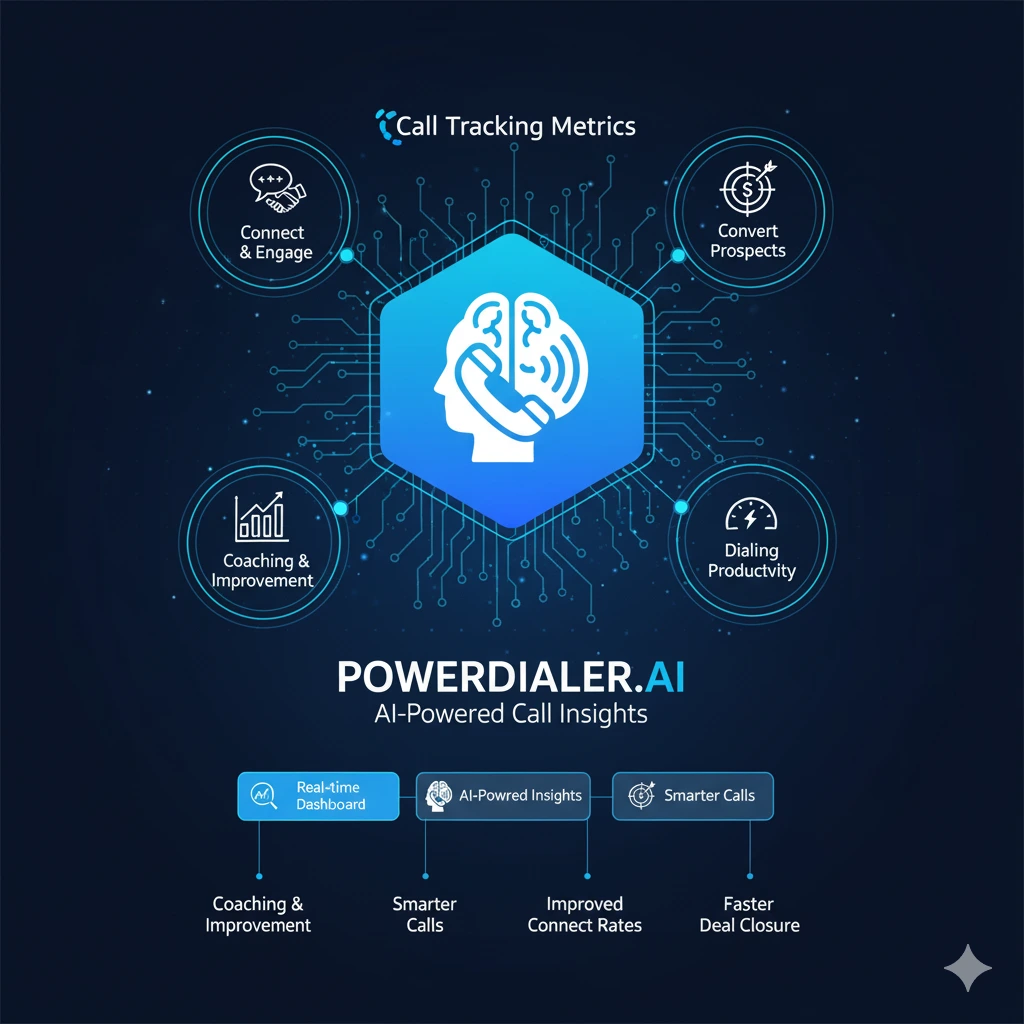
When it comes to tracking calls, PowerDialer.ai does more than just log numbers; it helps sales teams understand what those numbers mean. Its intelligent dialer analytics platform offers:
- AI-powered call summaries for quick reviews
- Automate activity tracking to eliminate manual data entry.
- Performance coaching tools based on real call data
- Real-time dashboards to monitor every key metric
With PowerDialer.ai, you don't just track calls, you optimize them. Every SDR, manager, and leader gains the insight they need to improve connect rates, shorten sales cycles, and grow revenue faster.
Ready to supercharge your team's productivity? Book a free demo with PowerDialer.ai
and see how smarter tracking leads to better selling.
Conclusion
Mastering these call tracking metrics is the key to long-lasting sales growth. Analyzing call volume, connect rate, conversion rate, and follow-up performance will let your team make wiser decisions and drive measurable results.
With modern AI dialers such as PowerDialer.ai, it becomes much easier to automate call tracking, visualize performance, and effectively coach-all on one platform.
It’s time to put your metrics to work if you are serious about improving productivity for your team and dialing efficiency.
Request a demo with PowerDialer.ai today and see how data-driven dialing transforms your sales performance.
FAQs
Q1. What are call tracking metrics in sales?
Call tracking metrics are measurable indicators like call volume, connect rate, and conversion rate that show how effective your sales calls are in generating results.
Q2. How can tracking of calls improve SDR performance?
Tracking the calls provides SDRs with insights on where they lost their prospects, or what tactics and scripts helped elicit better responses.
Q3. What's the best way to monitor call metrics automatically?
Because it integrates with your CRM, smart dialers like PowerDialer.ai ensure that all call data, notes, and outcomes are captured and analyzed automatically.
Q4. What is the most important metric in Outbound Sales calling?
While every metric is of value, connect rate and conversion rate remain the strongest indicators of true sales impact.
Q5. How frequently should sales teams review call metrics?
Consequently, it is best to monitor call performance on a daily or weekly basis to keep the team accountable and performing consistently.