
Autodialer laws govern how businesses can legally use automated calling technology to contact consumers and businesses. For sales teams, understanding these regulations isn't optional it's essential to avoid devastating fines that can reach tens of thousands of dollars per violation. The legal landscape surrounding autodialer technology has evolved significantly, especially following key Supreme Court rulings that redefined what constitutes an automatic telephone dialing system (ATDS) under federal law.
Sales development representatives, managers, and business owners operating in B2B environments must navigate a complex web of federal and state regulations. The Telephone Consumer Protection Act (TCPA) serves as the cornerstone of autodialer legislation in the United States, but it's complemented by FTC rules, state-specific laws, and industry-specific regulations that vary by sector. Whether you're using a power dialer, parallel dialer, or predictive dialer, compliance is non-negotiable.
This comprehensive guide breaks down everything sales teams need to know about autodialer laws, from understanding what qualifies as an autodialer to implementing compliant calling practices that protect your business while maximizing outreach efficiency. We'll explore recent court decisions, consent requirements, do-not-call obligations, recordkeeping mandates, and practical compliance strategies that keep your sales operation legally sound and operationally effective.
Understanding the TCPA and Autodialer Definition
The Telephone Consumer Protection Act of 1991 established the foundational framework for regulating automated calling systems in the United States. At its core, the TCPA prohibits the use of an automatic telephone dialing system to make calls to cell phones without prior express consent from the recipient. The law also restricts prerecorded voice messages and artificial voice calls to residential and wireless numbers.
For years, the definition of what constituted an ATDS under the TCPA was subject to broad interpretation by courts, creating uncertainty for businesses using dialing technology. Some courts adopted expansive definitions that encompassed nearly any equipment with the capacity to dial numbers automatically, while others applied narrower interpretations focused on random or sequential number generation capabilities.
In 2021, the Supreme Court provided critical clarity in Facebook v. Duguid narrowing the ATDS definition under the TCPA. The Court held that to qualify as an automatic telephone dialing system, equipment must have the capacity to use a random or sequential number generator to either store or produce phone numbers to be called. This landmark decision significantly narrowed the scope of what equipment falls under TCPA restrictions, providing relief to businesses using targeted dialing systems with predetermined lists.
The practical impact of this ruling means that most modern power dialers and sales dialers that call from uploaded contact lists rather than generating numbers randomly do not meet the technical definition of an ATDS. However, this doesn't exempt businesses from other TCPA requirements, including consent obligations, do-not-call compliance, and call time restrictions.
Consent Requirements: Express Written Permission
Even if your dialing technology doesn't qualify as an ATDS under the narrowed Facebook v. Duguid definition, obtaining proper consent remains the most critical component of TCPA compliance. The law distinguishes between two types of consent: prior express consent and prior express written consent, each with different requirements and applications.
Prior Express Consent
Prior express consent applies to informational, non-marketing calls. This type of consent can be obtained orally and doesn't require written documentation. Examples include appointment reminders, service notifications, or informational updates related to an existing business relationship. For B2B sales teams conducting outreach to established clients or prospects who've previously engaged with your company, this standard often applies.
Prior Express Written Consent
Prior express written consent is required for telemarketing calls made using an autodialer or prerecorded voice to wireless numbers. This higher standard requires a clear, conspicuous written agreement that specifically authorizes your company to make marketing calls to the provided number. The consent must include the telephone number to be called and cannot be a condition of purchasing goods or services.
Best practices for obtaining compliant written consent include using clear language in web forms, displaying consent terms prominently during sign-up processes, and maintaining detailed records of when and how consent was obtained. For sales teams using CRM-integrated dialing software, documenting consent status directly in contact records creates an essential audit trail.
Business-to-Business Exception
The TCPA provides an important exception for calls placed to telephone numbers assigned to business lines. Calls to business numbers aren't subject to the same consent requirements as calls to residential or wireless numbers, giving B2B sales teams more flexibility. However, determining whether a number is truly a business line versus a cell phone assigned to an individual requires due diligence, and businesses should still respect internal do-not-call requests from business contacts.
Do-Not-Call Registry Compliance
The National Do Not Call Registry, administered by the Federal Trade Commission, provides consumers a mechanism to opt out of telemarketing calls. Under the FTC Telemarketing Sales Rule guidance on outbound call restrictions and recordkeeping, telemarketers must consult the registry at least every 31 days and avoid calling numbers that have been registered for three months or longer.
Violations of do-not-call provisions carry severe penalties. The FTC can impose civil penalties exceeding $50,000 per violation after adjustments for inflation, making non-compliance extraordinarily expensive. For sales organizations making hundreds or thousands of calls daily, even a small percentage of violations can result in crushing financial liability.
Established Business Relationship Exemption
The Telemarketing Sales Rule provides a safe harbor exemption for businesses that have an established business relationship (EBR) with a consumer. An EBR exists when a consumer has purchased, rented, or leased goods or services from your company within the 18 months preceding a telemarketing call, or when a consumer has made an inquiry or application within the three months preceding such a call.
However, this exemption terminates if the consumer specifically asks not to be contacted again. When a prospect or customer requests to be placed on your internal do-not-call list, you must honor that request permanently, regardless of any prior business relationship. Implementing robust internal suppression lists and training sales teams to recognize and record opt-out requests is essential.
Scrubbing and List Management
Effective compliance requires systematic 'scrubbing' of calling lists against both the National Do Not Call Registry and your company's internal suppression list. Modern AI-powered dialing platforms can automate this process, flagging or removing non-compliant numbers before calls are placed. This proactive approach significantly reduces violation risk while improving operational efficiency.
Call Time Restrictions and Frequency Limits
Federal regulations impose specific restrictions on when telemarketing calls can be made. The TCPA prohibits calls to residential numbers before 8:00 AM or after 9:00 PM in the recipient's local time zone. While these restrictions technically apply to residential lines rather than business numbers, best practices suggest respecting reasonable calling hours for all outreach to maintain professionalism and avoid complaints.
State laws may impose additional time restrictions that are more stringent than federal requirements. Sales teams operating across multiple states must understand and comply with the most restrictive applicable rules. For example, some states prohibit calls on Sundays or establish earlier cutoff times in the evening.
Frequency and Abandonment Rates
Beyond time-of-day restrictions, the FTC's Telemarketing Sales Rule establishes requirements for predictive dialers related to call abandonment. If your sales operation uses technology that connects multiple calls simultaneously to a single agent (a true predictive dialer), you must ensure that no more than 3% of calls answered by consumers are 'abandoned' over a 30-day period.
An abandoned call occurs when a consumer answers but no agent is available to speak with them within two seconds. High abandonment rates frustrate consumers and trigger complaints, making compliance with this standard essential even for organizations not using traditional predictive technology. Using power dialers instead of predictive dialers can help avoid these abandonment issues entirely.
State-Specific Autodialer Laws
While the TCPA provides federal baseline standards, many states have enacted their own laws regulating automated calling practices. These state laws often impose additional requirements beyond federal standards, creating a patchwork of compliance obligations for businesses operating nationally.
California Regulations
California's laws are among the most stringent in the nation. The California Automatic Dialing-Announcing Device (ADAD) statute prohibits the use of automated systems to contact consumers without prior written consent, with limited exceptions. California also provides a private right of action, allowing consumers to sue businesses directly for violations.
Florida Requirements
Florida law prohibits automated calls to residential numbers unless the called party has given prior express written consent or unless an established business relationship exists. Florida's statute includes specific disclosure requirements for prerecorded messages, including identification of the caller and provision of a telephone number or address.
Other State Variations
States including Texas, Oklahoma, Pennsylvania, and Louisiana have enacted their own autodialer restrictions with varying definitions, consent requirements, and penalties. Some states require registration of automatic dialing equipment with state authorities, while others impose stricter definitions of what constitutes automated calling technology. For sales teams using international calling capabilities, understanding these state-by-state variations becomes even more complex.
Industry-Specific Compliance Considerations
Certain industries face additional regulatory layers beyond general TCPA and FTC requirements. Healthcare, financial services, education, and other regulated sectors must navigate industry-specific rules that impact calling practices.
Healthcare and HIPAA Intersection
Healthcare organizations using autodialer technology must comply with both TCPA requirements and HIPAA privacy rules. Leaving voicemails containing protected health information on unsecured personal devices can create HIPAA violations, even if the call itself is TCPA-compliant. Healthcare sales teams and providers should use HIPAA-compliant dialing solutions that encrypt data and provide secure message delivery.
Financial Services Regulations
Financial institutions are subject to overlapping regulations from the Consumer Financial Protection Bureau, state banking regulators, and federal agencies. The Barr v. American Association of Political Consultants on the constitutionality of the autodialer ban addressed specific TCPA exemptions for government debt collection, but commercial financial services must still maintain strict consent and compliance protocols. Financial services teams benefit from platforms that integrate compliance checks directly into calling workflows.
Education and Student Recruitment
Educational institutions recruiting students face scrutiny under both TCPA and Department of Education regulations. The use of autodialer technology to contact prospective students requires careful attention to consent mechanisms and opt-out procedures. Education and e-learning organizations should implement documented consent processes and maintain robust records of all communications.
Caller ID Spoofing and Truth in Caller ID Act
The Truth in Caller ID Act prohibits transmitting misleading or inaccurate caller ID information with the intent to defraud, cause harm, or wrongfully obtain anything of value. While this law targets malicious spoofing rather than legitimate business practices, sales teams must ensure that displayed caller ID information accurately represents their organization.
Using local presence dialing where calls display local area codes matching the recipient's location generally doesn't violate spoofing prohibitions as long as the number displayed is genuinely assigned to your business and you're not intentionally deceiving recipients about your identity. However, caller ID reputation management requires ongoing monitoring to ensure your numbers aren't flagged as spam by carriers or third-party apps.
Recordkeeping and Documentation Requirements
Robust recordkeeping practices form the foundation of sustainable compliance. The Legal text of 47 U.S. Code § 227 specifying TCPA autodialer and prerecorded call restrictions establishes that businesses must be able to demonstrate compliance when challenged. This requires maintaining detailed records of consent, do-not-call requests, calling activity, and compliance procedures.
Essential Documentation
Sales organizations should maintain records including: consent forms and timestamps showing when and how consent was obtained; do-not-call scrubbing reports demonstrating regular registry consultation; internal suppression list updates reflecting opt-out requests; call logs with date, time, duration, and disposition; agent training records documenting compliance education; and written policies and procedures governing calling practices.
Modern analytics and reporting features in sophisticated dialing platforms can automate much of this recordkeeping, creating compliance audit trails without requiring manual documentation by sales representatives.
Litigation Risks and Penalties
TCPA litigation has become a significant liability for businesses across industries. The statute provides for statutory damages of $500 to $1,500 per violation, and violations are counted on a per-call basis. A systematic calling practice that violates TCPA requirements can quickly generate liability in the millions of dollars.
Class Action Exposure
The TCPA's private right of action allows consumers to bring lawsuits individually or as class actions. Class certification in TCPA cases has become increasingly common, amplifying potential damages exponentially. A single compliance failure affecting hundreds or thousands of calls can evolve into a class action threatening a company's financial viability.
Regulatory Enforcement
Beyond private litigation, the Federal Communications Commission enforces TCPA violations and can impose civil forfeitures. The FTC similarly enforces Telemarketing Sales Rule violations with substantial penalties. State attorneys general can bring enforcement actions under state consumer protection laws, adding another layer of regulatory risk.
Implementing Compliant Dialing Practices
Achieving and maintaining compliance requires a systematic approach combining technology, training, and ongoing monitoring. The following best practices help sales organizations minimize legal risk while maximizing calling efficiency.
Consent Verification Workflows
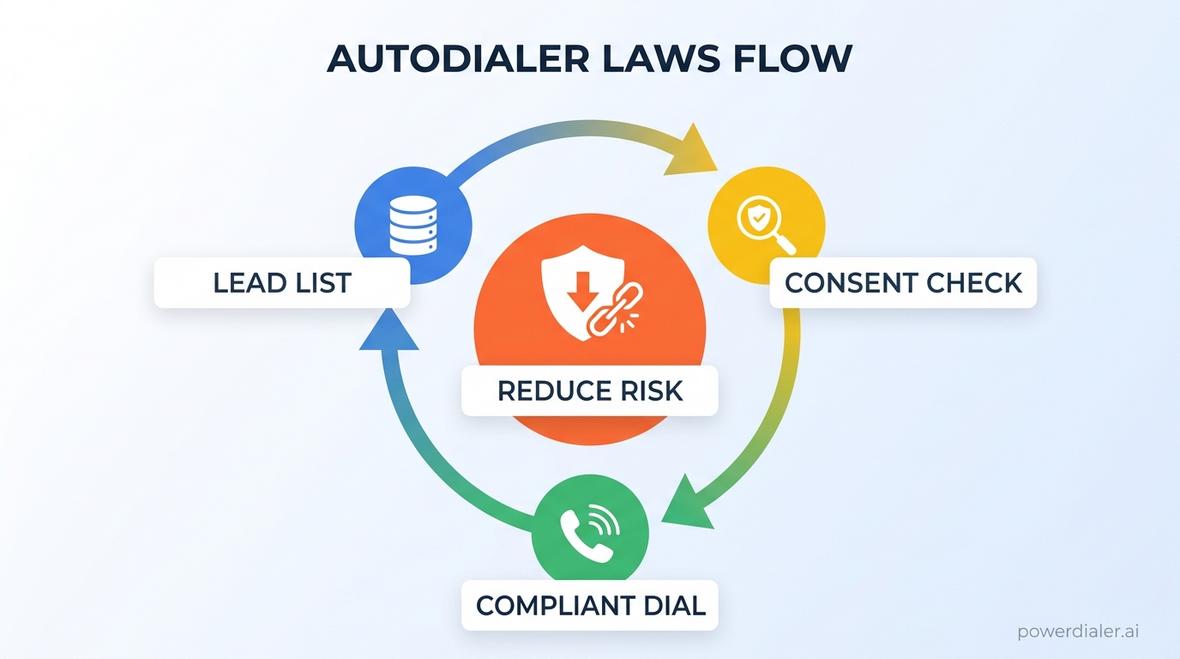
Implement automated consent verification before initiating calls. Your dialing platform should flag contacts lacking documented consent and prevent calls to those numbers until proper authorization is confirmed. AI-powered power dialers can integrate consent status directly from your CRM, creating a seamless compliance checkpoint.
List Scrubbing Automation
Automate the process of scrubbing calling lists against the National Do Not Call Registry and internal suppression lists. Configure your dialing system to perform these checks before calls are placed rather than relying on manual verification by individual sales representatives.
Call Monitoring and Quality Assurance
Implement real-time call monitoring to ensure agents follow compliant scripts and properly handle opt-out requests. Recording calls (where legally permissible with appropriate consent) creates documentation for training purposes and provides evidence of compliance practices.
Ongoing Training and Education
Conduct regular compliance training for all sales team members, covering TCPA requirements, consent obligations, do-not-call rules, and proper handling of opt-out requests. Update training materials whenever laws change or new court decisions impact compliance requirements. Using AI sales coaching features can help reinforce compliant calling behaviors in real-time.
Technology Selection and Configuration
Choose dialing technology designed with compliance features built-in rather than bolted on. Platforms offering integrated consent management, automated scrubbing, time-zone detection, and compliance reporting reduce the burden on individual representatives while providing institutional safeguards. Comparing different dialing solutions based on compliance features should be a priority in vendor selection.
The Future Regulatory Landscape
Autodialer laws continue to evolve as technology advances and regulatory bodies respond to consumer complaints and industry practices. Sales organizations must stay informed about pending legislation, FCC rulemakings, and court decisions that could impact compliance obligations.
Recent trends suggest continued focus on consumer protection, with regulatory agencies exploring additional restrictions on calling practices and enhanced consent requirements. The rise of AI-powered calling technology has drawn regulatory scrutiny, with questions about how artificial intelligence fits within existing legal frameworks.
Proactive compliance requires monitoring these developments and adapting practices as regulations change. Partnering with legal counsel experienced in telecommunications law and maintaining flexible technology infrastructure that can accommodate regulatory changes positions organizations to respond quickly to new requirements.
Frequently Asked Questions About Autodialer Laws
What exactly is an autodialer under current law?
Following the Supreme Court's decision in Facebook v. Duguid, an autodialer is equipment that uses a random or sequential number generator to store or produce phone numbers and dial those numbers. Most modern power dialers calling from predetermined contact lists don't meet this definition.
Are B2B calls exempt from TCPA requirements?
Calls to telephone numbers assigned to business lines are generally exempt from TCPA consent requirements. However, determining whether a number is truly a business line requires diligence, and businesses should still honor opt-out requests from business contacts.
What's the difference between express consent and express written consent?
Express consent can be obtained orally and applies to informational, non-marketing calls. Express written consent requires a clear written agreement and is mandatory for telemarketing calls made using autodialers or prerecorded messages to wireless numbers.
How often must I update my do-not-call list?
The National Do Not Call Registry must be consulted at least every 31 days. Internal suppression lists should be updated immediately when opt-out requests are received and integrated into calling systems before the next campaign.
Do state laws apply if I'm calling from another state?
Generally, the laws of the state where the recipient is located apply to the call, not the state where the caller is located. Businesses operating nationally must comply with the laws of all states where they have calling activity.
What are the penalties for TCPA violations?
Statutory damages range from $500 to $1,500 per violation, with violations counted on a per-call basis. Additional penalties can apply under FTC rules and state laws. Class action exposure can amplify damages exponentially.
Conclusion
Autodialer laws represent a complex but navigable regulatory landscape for sales teams committed to compliance. Understanding TCPA requirements, consent obligations, do-not-call rules, and industry-specific regulations protects your organization from devastating legal liability while maintaining effective outreach capabilities. The key to sustainable compliance lies in implementing systematic processes combining technology safeguards, comprehensive training, and ongoing monitoring. By selecting compliant dialing platforms, documenting consent rigorously, scrubbing lists regularly, and respecting consumer preferences, sales organizations can achieve their revenue goals while honoring legal obligations. As regulations continue to evolve, maintaining flexibility and staying informed about legal developments ensures your calling practices remain compliant and your business protected.